Canadian Underwriter

Category: Industry

  • How reinsurance rates, auto losses factored into industry’s 2025 results

    How reinsurance rates, auto losses factored into industry’s 2025 results

    A flooded supermarket after record-breaking rainfall.

    Canada’s property and casualty (P&C) insurers posted strong underwriting performance in 2025, despite a massive rise in reinsurance expenses following 2024’s record Cat year.

    And auto results remained weak but improved from the previous year, according to a 2025 year-in-review from the Property and Casualty Insurance Compensation Corporation’s (PACICC) latest quarterly Solvency Matters report.

    In 2024, insurers paid out more than $9 billion in severe weather-related insured losses. Last year, insurers benefitted from a comparatively mild Canadian catastrophe season — about $7 billion less than 2025 at $2.4 billion.

    “However, the industry did experience a sharp rise in Net Expenses from Reinsurance Contracts Held — which increased 593% in 2025, driving an unfavourable $6.9 billion swing between reinsurance premiums paid and claim recoveries — effectively mirroring the year-over-year catastrophe loss results,” writes Jeff Stewart, PACICC’s vice president of finance.

    Still, the industry’s underwriting performance remained strong last year. Insurance Service Expenses declined by 4.1% and Insurance Revenues climbed 6.5%, together driving a $3.45 billion increase in the Net Insurance Service Result — up a substantial 29.9% year-over-year.

    Stewart notes Canadian P&C insurers turned in a “standout performance” in 2025, delivering robust profitability and a return on equity (ROE) of 17.1%. “The result marks a notable step up from the 14.9% posted in 2024 and sits roughly 700 basis points above the industry’s 50-year long-run average,” he writes. “The results for 2025 mark the 6th consecutive year with ROEs above the long-run average.”

    Auto results

    When it comes to auto, 2025 underwriting performance in Canada’s private passenger auto insurance market remained notably weak. Last year, private passenger auto Net Comprehensive Combined Ratios (NCCRs) exceeded 100% in every province and territory except Quebec, Ontario and the Northwest Territories.

    NCCR incorporates Insurance Service Expenses, Reinsurance Costs, General and Operating Expenses, as well as Net Insurance and Reinsurance Finance Expenses relative to Net Insurance Revenue. An NCCR above 100% means an underwriting loss and indicates the line of business is eroding the industry’s capital base.

    “While the industry-wide result sits at 100.7% and has improved modestly by 2.8% compared to last year, these outcomes nonetheless underscore the persistence of an unsustainable trend,” Stewart writes.

    The report doesn’t indicate what contributed to the unprofitability. But Insurance Bureau of Canada reported Thursday that despite a recent drop in auto thefts, claims remain historically high.

    For example, over the last ten years, theft-related insurance claims increased by 38%. Over the same period, the value of theft claims increased by 169%, IBC says. Last year, the value of theft claims was $724 million, up from $269 million ten years ago.

    Wildfire woes

    For the industry, Canada’s second-worst fire season in 2025 also weighed heavily on personal property insurance results, particularly across Newfoundland and Labrador, Manitoba and Saskatchewan.

    “Each of these provinces reported NCCRs above 100%, with underwriting performance deteriorating most sharply in Newfoundland and Labrador and Saskatchewan, where ratios climbed beyond 120%,” PACICC’s report says. “Beyond the wildfire-impacted regions, PEI and Nunavut also recorded unfavourable NCCRs for the year.”

    Not surprisingly, commercial property and liability insurance remained the most profitable segments for Canada’s P&C insurers in 2025, with “highly positive” NCCRs of 89.3% and 87.9%, respectively. The line continues to see ample capacity and downward pressure on rates.

    The only localized exceptions to NCCRs over 100% emerged in Newfoundland and Labrador in commercial property, and Yukon in both commercial property and commercial liability. “These isolated areas of underperformance stand out against an otherwise broadly favourable commercial underwriting environment,” PACICC says.

    Looking at combined results by province, Newfoundland and Labrador stood out as the sole jurisdiction reporting an unfavourable result in 2025, with an NCCR of 106.8%. By contrast, Quebec, British Columbia, the Northwest Territories and Nunavut all delivered highly favourable outcomes, each posting NCCRs below 90%.

    Underwriting profitability across PACICC’s 160 member insurers continues to vary. In 2025, approximately 9% of insurers reported negative Net Insurance Service Results.

    “No single trend, however, appears to explain these outcomes,” Stewart writes. “Instead, weaker performance was driven by insurer-specific circumstances, often tied to unfavourable underwriting in select product lines or a high concentration of exposure within particular provinces.”

  • Is the Liberal majority strong enough to pass policies endorsed by the P&C industry?

    Is the Liberal majority strong enough to pass policies endorsed by the P&C industry?

    Several balancing geometric shapes. 3D rendering

    When it comes to the federal government’s power to push through policies championed by Canada’s property and casualty insurance industry, don’t underestimate how tenuous the Liberal government’s majority is, speakers cautioned at the Insurance Institute of Canada’s CIP Society Symposium 2026, held in Toronto last Thursday.

    “Are we going to see more [floor-crossers] to make that legislative agenda a little bit easier to pass through? Only time will tell,” said Evan Stubbings, director of government affairs at Desjardins Group. “But I think the reason it’s key is because we need to see this government move from ideation to execution.

    “Because, over the last year…they have sort of been stuck in neutral. And they’ll only be able to switch that…once they have like the votes to do so.”

    The Liberal government has a number of items on the agenda of interest to Canadian P&C professionals. A majority Liberal government suggests a stronger push to move on industry-endorsed projects.

    For example, the federal government is working on establishing an earthquake insurance backstop, creating a flood insurance backstop, supporting climate-related risk and resilience projects, and curbing auto theft, among others.

    After the federal election in April 2025, Insurance Bureau of Canada told Canadian Underwriter it was encouraged by the strength of the Liberals’ minority government.

    “It’s good news to have a relatively stable government for a change,” Stewart told CU in an interview after the election. “Although it’s a minority, it’s a very strong minority, and we expect that we’re going to have, at least for the next two years, a stable and constructive Parliament, which certainly hasn’t been the case over the last few years.”

    However, Stubbings said the “razor-thin” majority still needs about three more floor-crossers for the government to advance its policy agenda confidently.

    On Apr. 13, 2026, the Liberal government won three byelections held in Scarborough Southwest (Ontario), University–Rosedale (Ontario), and Terrebonne (Quebec).

    In addition, five opposition party members — four Conservative MPs and one NDP MP — have crossed the floor to join the Liberals since the Liberals’ minority win in the 2025 election.

    The governing party now has 174 seats in Parliament. It needs 172 seats for a majority government.

    Also in the news: Why Ontario’s new tow truck regulations aren’t reducing insurers’ costs

    But with two more anticipated bylaws in the future, it’s quite possible the Liberal government’s majority may not be as strong as it is now, Stubbings cautioned.

    He referenced media reports suggesting Liberal MP for North Vancouver, Jonathan Wilkinson, the former energy and natural resources minister, may resign to get a diplomatic post somewhere. And Nathaniel Erskine-Smith, the Liberal MP for Beaches-East York in Toronto, has reported an interest in resigning to run as leader of the Ontario Liberal Party.

    “That brings you back to 172 [seats],” said Stubbings. “Isn’t that fine? It’s still a majority.

    “No, because the Speaker of the House is a Liberal, and the speaker, by custom, doesn’t actually get to vote on passing legislation unless it’s the event of a tie. So…once those two additional byelections come to fruition, as we expect them to, the Liberals won’t have a majority anymore, absent further floor-crossers. Which brings me back to the tenuous nature of that caucus.”

    Stubbings noted the Liberal government’s tent includes some floor-crossers with opposing ideological views on some key issues issues, which makes the nature of the Liberals’ majority government tenuous.

    “Are we actually going to see this legislative agenda advance, absent more floor-crossers?” Stubbings said. “I would say no.”

    He added the caveat the Liberals would need three more floor-crossers to maintain its majority in the face of two potential resignations.

  • What Canada’s earthquake backstop might look like

    What Canada’s earthquake backstop might look like

    Canada earthquake concept

    After 13 years advocating tirelessly for an earthquake backstop, the Property and Casualty Insurance Compensation Corporation (PACICC) has been asked to help flesh out exactly what the backstop would look like.

    “And the deadline was just seven weeks away!” PACICC president and CEO Alister Campbell writes in the corporation’s latest quarterly Solvency Matters report.

    Finance Canada launched a consultation on Feb. 24 to hear ideas on what an earthquake insurance cost-sharing arrangement might look like, following a desktop simulation demonstrating the scope and scale of Canadian earthquake exposure in British Columbia and Quebec. The federal government imposed a deadline of Apr. 10.

    “As I write this note, we are still developing our full, formal response to the Finance Canada consultation,” Campbell writes. “But the broad strokes are already clear and I am comfortable sharing — at a high level — what we are likely proposing to tell Ottawa.”

    One component of the model is that any proposed solution must cover both federally and provincially supervised insurers. “The cost-sharing arrangement needs to be a national mechanism, not just a federal one — in order to fully mitigate systemic writes,” Campbell says. He notes more than 60% of Quebec personal property insurance and 20% of B.C. personal property insurance is currently underwritten by provincial insurers.

    Quebec-based Desjardins Group is the largest provincially-regulated insurer. The inclusion of provincially regulated insurers in the cost-sharing arrangement is important, says Evan Stubbings, director of government affairs at Desjardins Group.

    “What we are looking for as an industry is a backstop and upfront liquidity to pay for those claims, because there is going to be a huge, huge influx when this happens,” Stubbings said last week at Insurance Institute of Canada’s annual CIP Society symposium in Toronto.

    Importance of inclusion

    Why does it matter that provincially regulated insurers are included?

    “We’re part of Desjardins Group, we have some capital. I think we’ll be okay,” Stubbings says. “But smaller players, if they start to fail because they aren’t part of that liquidity solution, the other carriers, including the federal ones, are just going to assume that risk anyways through their PACICC assessments…

    “We really wouldn’t be moving the needle whatsoever if we do not include the entire industry.”

    PACICC is also proposing a cost-sharing arrangement modelled on the U.S. terrorism backstop TRIA, the Terrorism Risk Insurance Act. It would be structured with a clear trigger or threshold, an appropriate deductible or net retention for the industry, and an upper bound on total government obligation with some sort of “re-coupment” model, Campbell writes.

    TRIA provides for a transparent system of shared public and private compensation for certain insured losses. The federal backstop applies only if total industry insured losses exceed the statutory program trigger.

    “Careful modelling and analysis will be required to set ‘trigger/thresholds’ and the industry ‘deductible’ in the ‘TRIA-like’ structure,” Campbell writes. “To the extent that any successful design will need to allow insurers ‘to fail’ (as antidote for ‘moral hazard’), there will also need to be accurate modelling to estimate how much failure the system can ‘afford.’

    “It seems very possible that the PACICC Systemic Risk Model (encompassing both federal and provincial insurers) will prove to be invaluable in supporting this modelling work.”

    A recoupment mechanism will likely be a central element of the arrangement. This will enable the industry to repay funds received from the federal government over a period of time after the major earthquake event, Campbell notes.

    Lastly, “it is past time for Finance Canada to formally designate PACICC as a ‘compensation association’ under the federal Insurance Companies Act.”

    Desktop simulation to formal consultation

    The most recent earthquake developments occurred in mid-December in Ottawa after the Office of the Superintendent of Financial Institutions hosted PACICC and the Insurance Bureau of Canada. The industry engaged federal and provincial stakeholders in a desktop simulation demonstrating the scope and scale of earthquakes in B.C. and Quebec.

    That exercise provided modelled estimates for two “scientifically credible” events, and the resulting total ground-up losses and insured losses, as well as an evaluation of the likely damage to strategic infrastructure assets such as airports, ports and power plants. Modelling also included fiscal needs and expected impacts to overall GDP and government revenues.

    Desktop simulation participants were shown events that would send PACICC member insurers past the ‘tipping point,’ causing them to fail and fuelling systemic contagion. The success of the simulation prompted the formal consultation.

    “We anticipate the next few weeks and months to be quite hectic, as we work with all industry and federal/provincial stakeholders to get to the finish line on design of an effective liquidity backstop mechanism,” Campbell writes. “And it is realistic to assume there will be at least a few more bends in the road before we get there.

    “But after 13 years of effort, it is clear that we have never been closer to seeing — and perhaps even being part of — a solution to address this glaring gap in the public infrastructure of Canada.”

  • Fewer brokers say they plan to leave their jobs

    Fewer brokers say they plan to leave their jobs

    Job satisfaction metre

    They’re sticking around.

    Just 18% of brokers responding to Canadian Underwriter’s 2026 National Broker Survey say they’re likely to leave the profession within three years. That’s a reversal of a multi-year trend – 22% told last year’s survey they’d leave within three years, as did 29% in 2024, 32% in 2023 and 24% in 2022.

    Why are they staying? Verbatim responses to this year’s survey include expected answers, like the need for income or concerns being able to afford to retire. But others laud their brokerage’s culture, the value derived from client relationships, supportive management that allows work from home, and the profession’s job security.

    “[I work in a] family business [and] would not leave unless it were for a very high pay increase,” says a woman respondent who’s newer to the business.

    Related: Why brokers are feeling the squeeze from directs

    Another suggests age isn’t always a deciding factor. “Thirty years in, I love the role of broker and am proud to devote my expertise to serving clients in this capacity,” says a woman respondent at a large firm. Others echo that sentiment, adding the effort they’ve put into developing their skillsets compels them to stick with the profession.

    Men, at 16%, are slightly more likely to say they’ll leave within three years than women, at 15%. Predicably, 33% of industry veterans who’ve been in the business for 31 or more years plan to leave within three years, followed by newer brokers with 16 or fewer years on the job (12%), and those at mid-career (5%) with between 16 and 30 years under their belts.

    In terms of firm size, brokers at larger companies with 100 or more employees are most likely to say they plan to leave the industry sooner than later (17%), followed by brokers at small firms with 20 or fewer employees (15%), and those at mid-sized operations with 20-to-99 employees (12%).

    Stress points

    Comments seen in prior-year surveys from brokers who say they’ll leave due to stress, pay concerns, and workload all show up in the 2026 data. This year’s survey has a stack of verbatim responses simply saying “retirement.”

    But those answers are joined this year by verbatims pointing to structural changes in how insurers and brokers interact, as well as frustration with client demands.

    “The constant industry changes, including more pressure on brokers to do the work of underwriters and claims adjusters, [while] our commissions have never changed,” says one mid-career broker at a smaller firm. “Clients are so focused on price and want answers ASAP. The high-paced environment and pressure is becoming too stressful and overwhelming after 22 years in the industry. I can rarely take a day off without [having to do some work].”

    Related: Why brokers’ dreams for business succession may not come true

    One broker newer to the business adds, “Clients have become more upset and entitled. They’re unhappy with premiums and take it out on us. They want everything instantly. They’re rude, and they never take responsibility for paying on time, reading their policies, [or] answering questions honestly. They’re quick to blame us for their decisions.”

    Another broker sees brokerage consolidation as a motivator to leave the business. “I enjoy being my own boss and helping clients,” says a respondent who provided no age or firm-size details. “Large brokerages are taking over, and insurers increasingly cater to them and not smaller shops. Lack of autonomy will make me leave.”

    Job satisfaction

    In a separate question in the 2026 survey, 74% of brokerage employees say they are satisfied with their current employers (8 through 10 on a 10-point scale), compared with 68% in 2025, and 78% in both 2024 and 2023. Only 1% place themselves at the bottom of the range (0 through 3 on a 10-point scale) in 2026, compared with 4% in 2025 and 3% in 2024.

    At 77%, women are more likely than men (69%) to say they’re satisfied with their employers. Those at mid-career (76%) express the highest satisfaction levels, followed by newer and older brokers (both at 72%). Those at mid-sized firms (79%) are most likely to express employer satisfaction, followed by those at small companies (72%) and large operations (63%).

    Canadian Underwriter’s 2026 National Broker Survey heard from 169 brokers, with 32 identifying as brokerage owners or principals. The survey was conducted in February 2026, with support from Sovereign Insurance.

  • Why Ontario auto reform may drive more lawsuits

    Why Ontario auto reform may drive more lawsuits

    Man injured in auto accident

    Multiple Canadian Underwriter sources believe Ontario’s auto reforms to be introduced this summer could spark new lawsuits – or even endanger the assets of some insureds.

    Ontario has a hybrid private auto insurance system that pays out accident benefits to insured drivers injured in auto collisions. It also has a tort system allowing injured drivers to sue to recover compensation for their injuries from at fault drivers. As of July 1, Ontario is making several mandatory accident benefits optional, including income replacement and housekeeping benefits, so that insured drivers can save money on premium by opting not to receive optional benefits.

    However, the industry is wondering if any savings gained from the optional accident benefits side may in fact increase costs on the tort side.

    Now, and after July 1, Ontario drivers are required carry minimum liability coverage providing protection in the event they’re found legally responsible for injuries or damages to others, notes Michelle Dodokin, head of auto insurance supervision at the Financial Services Regulatory Authority of Ontario (FSRA).

    “In the Ontario system, the right to sue is limited to accidents causing certain serious or permanent injuries as defined by the Insurance Act,” she tells CU. “The right to sue is based on respective fault for the cause of an accident.”

    If consumers are concerned, she adds, they should review their policies with their brokers or insurance agents.

    Related: Optionality could leave passengers, even children, without auto coverage

    All Ontario drivers carry a mandatory $200,000 of personal liability insurance that covers drivers for claims against them if they’re at fault in an accident, “against claims for compensation from not-at-fault victims up to that limit,” says David Marshall, who has served as a senior advisor to the Government of Ontario on auto insurance and pension funds.

    He says if the claim exceeds $200,000, the driver would be liable to pay the excess “from their personal assets unless they have purchased excess coverage, which is optional.”

    He adds most drivers currently purchase about $1 million of personal liability insurance, “So, the risk of losing your home is minimal.”

    Industry experts have also raised questions about whether auto policies renewing after July 1 could leave uninsured injured persons, such as pedestrians or cyclists, without access to specific benefits they can currently access through an insured driver’s policy – such as income replacement, housekeeping, dependent care or death benefits. “There is no way to provide them with insurance under the new auto insurance rules in Ontario,” Marshall tells CU. “If they are not at fault and need these benefits, they will have to sue the at-fault driver, which is one of the reasons litigation costs are going to rise.”

    Dodokin stresses pedestrians and cyclists would still have access to the mandatory medical and rehabilitation accident benefits.

    “Additional coverages such as income replacement may also be available to them through supplementary benefits, such as disability coverage through employer benefit programs. Pedestrians and cyclists may also purchase a driver’s policy, which provides accident benefit coverages to someone that does not own their own vehicle,” she says. 

    Related: Opinion | Why Ontario pedestrians without auto insurance will need access to optional benefits  

    In some cases, uninsured people injured in auto accidents (and who cannot access insurance under the new rules) may be left with no choice but to sue, says Marshall.

    “It is important to understand that a person can sue an at-fault driver for economic loss – for example, the cost of health care and wage loss,” he tells CU. “They can also sue for non-monetary loss called ‘pain and suffering,’ but this latter category needs proof that you have suffered a serious permanent injury. And there is also a need to prove that your suffering is worth more than a given deductible which today is about $48,000.”

    In practical terms, Marshall says Ontario’s optionality reforms do mean innocent pedestrians or those who don’t have auto insurance, but whose needs exceed the $65,000 mandatory medical coverage (which they can access) will have to hire a lawyer and wait while the legal process runs its course. The same is true for those who experience wage loss.

    That can take “two or more years [for them] to get paid,” he notes.

    “In the meantime, they will have to pay for medical care [that’s] not covered by OHIP out of their own pocket and suffer wage loss till they can get back to work – unless they also have wage protection through an employer policy,” he says.

    He says both the changes, and the “sheer complexity of the new rules,” could increase disputes and litigation.

    Dodokin points out FSRA recognizes the insurance coverage changes can create questions for consumers, and that the regulator “collaborated with insurers and brokers to provide clear consumer information materials to ease this transition.”  

  • How Quebec flood maps could affect rates, coverage

    How Quebec flood maps could affect rates, coverage

    Topographic map of Quebec

    New Quebec flood zone maps could lead to higher home insurance premiums, coverage limitations and more complex underwriting for flood protection, CAA-Québec warns.

    Since March 2026, Quebec’s provincial government has gradually rolled out the new flood maps. These updated maps will have tangible insurance implications for homeowners, condo owners and tenants, CAA-Québec says.

    There’s not only a risk of higher insurance premiums, there’s also a possibility that insurance coverage for water damage may no longer be available to people who are now considered to live in flood zones, Suzanne Michaud, CAA Québec’s vice president of insurance, tells Canadian Underwriter.

    The new maps could also lead to coverage restrictions.

    “We could see restrictions of coverage for specific protections and endorsements, [such] as the ones for backflow of sewage, water damage above ground, flooding, water infiltration through the ground, [and] replacement value,” Michaud says.

    Some insurers may also require a check valve, submersible pump, the elevation of equipment such as furnaces and electrical panels, or land development requirements, she adds.

    Keep clients informed

    How do clients get information on the new flood maps?

    Michaud says information is first provided by the Government of Quebec. For now, municipalities and “municipalités regionals de comtés” (MRC – regional county municipalities, or county-like units of government) will receive the first-issued maps. Municipalities and MRCs will then study the maps to be able to answer questions from consumers when the maps are widely released.

    “Because it is clear that there will be questions from people who find themselves in the new flood-prone areas,” Michaud says, adding she knows there are “some negotiations with the MRCs and the government about who will be in charge to produce the final version of those maps, because of potential legal effects.”

    The Government of Quebec is updating its flood zone mapping to strengthen flood prevention and help communities better manage flood risks. It introduces new regulations and amends existing ones.

    The new flood maps differ from the old ones in many ways, Michaud tells CU.

    For example, the old maps had two zones based on flood recurrence frequency: 0-20 years (high risk) and 20-100 years (moderate risk). The new mapping is more realistic and easier to understand, considering type of flooding, frequency, water depth and the impact of climate change. It’s broken up into four zones, defined by descriptions and colours, for very high risk, high risk, moderate risk and low risk.

    The old maps only considered the probability of flooding, while the new ones consider those likelihoods, as well as depth of water, 25-year frequency and other conditions such as the presence of ice or dams. In addition, the new maps consider historical data, while also taking climate changes into account, and are reviewed every 10 years at a minimum.

    National implications

    Nationally, Canada’s emergency management minister, Eleanor Olszewski, says she can’t guarantee the government will launch the promised National Flood Insurance Program “in the near future.” Canadian Press reported last week Olszewski told reporters the program is still “top of mind” but it’s complicated to set up.

    Liam McGuinty, Insurance Bureau of Canada’s vice president of federal affairs, told CU the federal government continues to engage the P&C industry, provinces and territories on the design of the national program. The work includes exploring how a backstop would function alongside expanded flood coverage by Canada’s private home insurance market, he says.

  • Questions raised over Ontario trucking insurance website

    Questions raised over Ontario trucking insurance website

    Cat showing surprise!

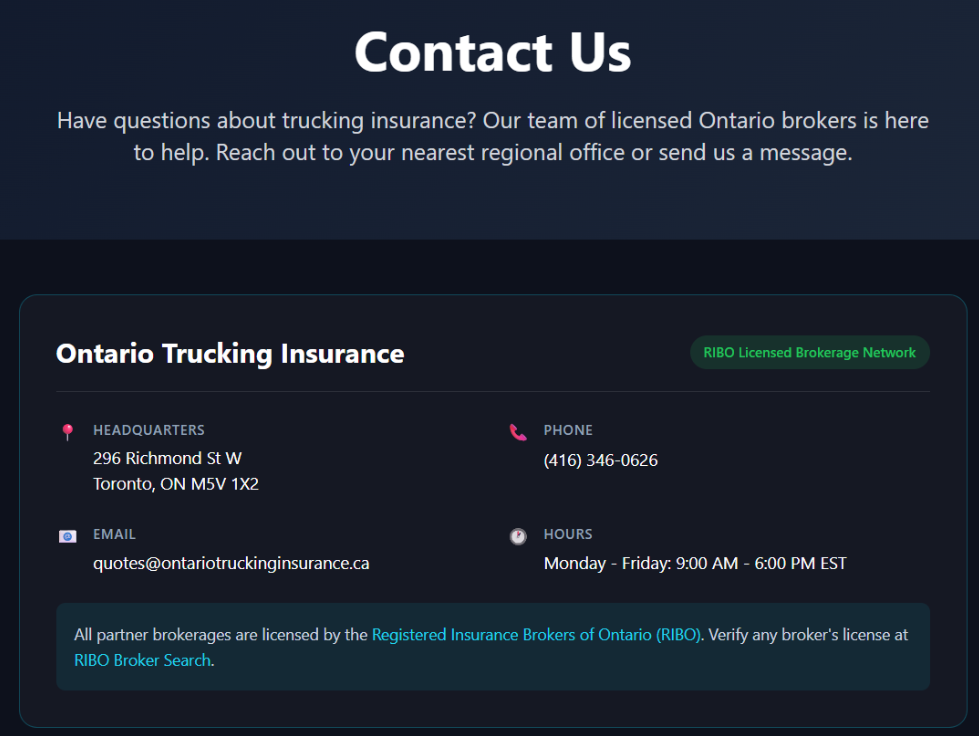
    An Ontario-based company offering trucking insurance quotes is raising concerns after multiple licensed brokers said they’re not affiliated with the operation, despite being listed on its website as part of its network early yesterday morning. Those same brokers saw their names and profiles replaced shortly after inquiries were made on April 23.

    The site, operating under the name Ontario Trucking Insurance, presents itself as a network of licensed professionals and directs users to submit information for quotes. But at least three of the nine Ontario brokerages whose profiles were initially displayed told CU‘s companion publication trucknews.com they have never heard of the organization and did not authorize the use of their names, images, or office details.

    The Richmond St. headquarters address listed by Ontario Trucking Insurance actually belongs to Mitch Insurance, which surprised CEO Adam Mitchell (screen capture).

    Those images, contact details and bios were included on a page that read, “Our Expert Team: Meet the licensed Ontario insurance brokers who write and review our content. Each expert brings decades of experience in commercial trucking insurance.”

    “I have never heard of them,” said Ian McCowan of D.G. Dunbar & Associates, one of the nine experts listed.

    Likewise, Joanna Mendonca, president of Staebler Insurance, said she is “not familiar with the organization” and does not recall providing any permission to be listed. “I believe I have never had any dealings or affiliation with them,” she added, describing the situation as “suspicious and concerning.”

    Staebler and Dunbar were among four identifiable Ontario brokerages whose addresses were listed on the site’s contact page, although McCowan indicated the photo shown was not of him. Screen captures of the web page were taken, but only after site’s owner altered the ‘team’s’ photos and contact details.

    RIBO reaches out

    Adam Mitchell, whose firm was also listed on the site, said the first he heard of it was when the province’s broker regulator, the Registered Insurance Brokers of Ontario (RIBO), contacted him April 23. RIBO asked Mitchell if he had authorized the use of his name. He said he had not.

    “It didn’t ring a bell,” Mitchell said of the company. “Once I saw the team and the makeup of a bunch of people, I knew there was no chance somebody had built a conglomerate of those people that are all still actively operating.”

    It would’ve been a dream team of Ontario insurance professionals, he noted.

    Mitchell said the site used his firm’s downtown Toronto office address, but reiterated had no connection to the operation. Ontario Trucking Insurance had no address of its own listed. But it did have a phone number. Trucknews.com called that number and received a recording saying: “Thank you for calling Trucking Insurance Quoting” and requested the caller leave their contact information “so we can get back to you as soon as possible to help you get a quote.” Trucknews.com submitted a form requesting a quote for coverage for a one-truck owner-operator, which as of press time had not been acknowledged.

    A search of RIBO’s online registry tool did not return any brokerage operating as Ontario Trucking Insurance. Licensed brokerages in Ontario are required to maintain a physical place of business and have a verifiable address on file with the regulator. The website not only claimed the entity was RIBO-registered, but also indicated it was a member of the Ontario Trucking Association (OTA).

    OTA told trucknews.com the company was not a member.

    The domain for the website was registered in December 2025, according to public WHOIS records, which did not include the website owner’s name or contact information.

    The website itself changed during the course of reporting on April 23, replacing a set of named brokers seen earlier on April 23 with another. The original nine Ontario brokers were replaced by nine new faces, some of whom appear to be U.S. insurance professionals, although some return no public profile. The phone number alongside each of their bios was that of Ontario Trucking Insurance.

    In the late afternoon of April 23, the ‘Team of Experts’ page which originally featured Canadian brokers was replaced with new images of brokers, some of whom appear to be U.S. based. Phone numbers below each broker profile go to Ontario Trucking Insurance (screen capture).

    There are several possible motivators behind the site. It could be intended to leverage the experience of legitimate insurance brokers to sell non-existent policies, leaving insureds uncovered. It could be used to generate leads, which the site owners could then sell to licensed brokers. Or the entity could be brokering insurance without authorization.

    Mitchell said the biggest concern in being linked is not just reputational, but the potential impact on fleets seeking coverage.

    “The one [thing] you’d hate to see is an honest customer that thinks they’re actively buying insurance for an incredibly expensive product and then finding out they have no coverage,” he said. “Cargo is not something you mess around with.”

    He noted that periods of economic pressure can bring an increase in questionable activity in the insurance space, including fraudulent documents and misrepresentation.

    While it’s not clear who is operating the website or how submitted leads are handled, industry experts say fleets should take steps to verify who they are dealing with before purchasing coverage.

    Mendonca recommends checking the RIBO registry to confirm that both the brokerage and individual broker are licensed and active.

    “That would at least confirm that the broker or brokerage is an active, licensed person or company,” she said.

    James Menzies is Executive Editor of Today’s Trucking and trucknews.com. This article first appeared on trucknews.com, a companion publication of Canadian Underwriter.

  • Exclusive insurance provider for Canada’s public sector launched

    Exclusive insurance provider for Canada’s public sector launched

    Aerial view of Heritage Park and Lake Simcoe in Barrie, Ont.

    Tributary Public Risk (TPR) has launched what it’s calling Canada’s first public sector-focused insurance provider.

    The Canada-domiciled company, based in Nisku, Alta., is now open for business exclusively for public sector clients. It delivers specialized insurance solutions through a licensed broker-based distribution model supported by data-driven underwriting and public sector expertise, TPR says Wednesday in a press release.

    TPR was established to address the distinct risk, governance and procurement needs of municipalities, schools, Crown agencies, risk pools/reciprocals, Indigenous communities and non-profit organizations, according to its website.

    Its insurance program offerings include owner controlled insurance programs (OCIP) for major construction projects; job order contract insurance programs (JOCIP) for repair, renovation, and maintenance work delivered through job order contracting; and parametric insurance designed to provide rapid, predetermined financial support following defined disaster-related events. TPR also offers property, casualty, auto (fleet), umbrella/excess, environmental, course of construction and wrap-up liability, and cyber liability.

    The launch comes amid sustained investment in public infrastructure across Canada.

    According to forecasts from ConstructConnect, civil construction is expected to be the primary driver of Canada’s construction market through 2027, growing by approximately 26% and increasing from $32.6 billion in 2025 to an estimated $41 billion by 2027. Civil projects are projected to account for nearly half of all non-residential construction activity nationally, reflecting a growing emphasis on public infrastructure delivery.

    At the same time, Canadian public entities are facing increasing financial exposure from extreme weather and natural disasters, TPR says. As the P&C insurance industry knows, insured losses from severe weather events hit a record $9.1 billion in 2024. Even though NatCat insured losses dropped to $2.4 billion last year, Cat losses remain an industry concern.

    Backed by procurement group

    TPR is backed by Canoe Procurement Group of Canada, a public sector solutions organization representing municipalities and other public entities across Canada. Through this relationship, TPR combines access to insurance markets with governance and oversight aligned to public sector values.

    “Public sector organizations face exposures that differ fundamentally from commercial risks,” says Chris Lorne, chief executive officer of TPR. “Tributary was built to serve that reality.

    “Our focus is on clear programs, responsive service, and insurance structures that fit how public entities plan, procure, and deliver services.”

    Lorne brings 26 years of insurance industry experience to the CEO role, with a career spanning underwriting, broking and executive leadership across both insurers and a global brokerage.

    Adds TPR board member Duanne Gladden: “For decades, municipalities and other public organizations have been telling us the same thing: their risks are different, and the insurance market has not always reflected that reality.

    “Tributary Public Risk was built from that experience. It is for the public sector, by the public sector, and grounded in a deep understanding of how public organizations operate, plan, and remain accountable to their communities,” says Gladden, who is also executive director and CEO of both Canoe Procurement Group of Canada and Rural Municipalities of Alberta.

    TPR says brokers may contact TPR directly regarding submissions and program details. The program is open to all licensed brokerages across Canada, excluding Quebec at this time.

    Public sector organizations are encouraged to contact their insurance broker to discuss the applicability of the programs.

  • How Canada’s commercial coverage rates fared in Q1 2026

    How Canada’s commercial coverage rates fared in Q1 2026

    Toronto skyline representing commercial enterprises that need to be insured

    Data are starting to support broker and insurer anecdotes about softening commercial insurance lines in Canada.

    Marsh’s global insurance market index (GIMI) report, a proprietary measure of commercial insurance rate changes at renewal, finds insurance rates in Canada declined 6% during Q1 2026, compared to a 7% decline in Q4 2025.

    Property

    Looking at individual sectors, Marsh’s report says property insurance rates slipped 6% during 2026’s first quarter and that competition levels are high. By contrast, rates fell 8% in the final quarter of 2025.

    Marsh adds surplus capacity and strong insurer appetite in the property market led to rising levels of competition. “Most quota-share placements were over-subscribed, contributing to greater concurrency of key deductibles and sub-limits,” the report adds.

    Further, reinsurance renewals for Jan. 1, 2026 generally displayed expanded capacity and insured losses that were well below the five-year average.

    Insurers also relaxed policy conditions in order to secure business, “broadening terms to offset downward rate pressure,” Marsh notes.

    Access to facilities helped clients seeking to improve their terms and/or costs. And the report says some clients redeployed premium savings into purchases of additional limits or lower retentions – “drawing on excess capacity and facility access to improve program structure and reduce cost.”

    Casualty

    Overall casualty insurance rates in Canada decreased 5% in 1Q 2026, matching the decline in 4Q 2025 and marking the 11th consecutive quarter of declines.

    “Clients with Canada-specific exposures seen as good risks by insurers typically benefitted from expanded capacity and price competition,” the report says. But it adds risks exposed to the U.S. and other complex risks did see selective rate increases – some of which were double-digits.

    For example, U.S. auto liability underwriting tightened, with higher attachments, shared loss structures, and telematics requirements for clients with those exposures.

    “Specialty capacity remained selective, especially for US-exposed and loss-impacted risks,” Marsh adds.

    Meanwhile, reinsurers emphasized limit management, higher attachments and reduced line sizes for accumulation risks. Scrutiny around underwriting also increased, “with a focus on higher attachments, sublimits, and/or per- and polyfluoroalkyl substances (PFAS) and pollution wordings.”

    “Underwriters scrutinized PFAS and wildfire risks, at times using exclusions, sublimits, and mitigation-linked pricing,” the report says.

    Depending on the specific risk, some clients emphasized fleet safety, telematics data use, and wildfire mitigation to improve terms and renewability, Marsh says. And, much like property clients, casualty clients also deployed premium savings into “additional casualty tower capacity.”

    Professional lines

    Rates for financial and professional lines in Canada declined 6% in 1Q 2026, slightly ahead of a 5% slip in 4Q 2025.

    Marsh’s index notes rates for directors and officers liability coverage experienced a low single-digit decrease. And while rate reductions continued in some program layers, the report says insurers generally resisted further decreases.

    “Rising fiduciary litigation tied to health and welfare plans is being watched, though without material impacts to underwriting or rates to date,” Marsh’s report says. And, “employment practices liability rates and exposures remained stable.”

    Cyber

    Rates for cyber insurance decreased 5% in 1Q 2026 in Marsh’s index. Capacity among insurers “expanded across excess and primary layers, including from new market entrants, increasing competition,” the report adds.

    What’s more, there was continued coverage expansion and fewer coinsurance requirements and broader sub-limited enhancements.

    “Organizations with strong cyber controls were well-positioned to negotiate lower retentions, broaden coverage, and capture excess-layer savings,” the report says.

  • Why LAT denied benefits for medical cannabis costs in auto accident case

    Why LAT denied benefits for medical cannabis costs in auto accident case

    Medical marijuana in prescription vial

    A person involved in a 2020 auto accident cannot claim benefits for medical cannabis, in part because the insurer provided some evidence the treatment may not have been helpful, according to an Apr. 16 decision by Ontario’s Licence Appeal Tribunal (LAT).

    TD General Insurance denied benefits for a treatment plan submitted by Amit Missra, who claimed benefits for medical cannabis proposed by a doctor in 2022 as well as a social work assessment claim in 2022. LAT adjudicator Jeff Chatterton upheld the insurer’s denial of the medical cannabis claim, but did grant payment for the social work assessment and related interest costs.

    Missra noted treatment plans calling for medical cannabis pharmaceuticals were prescribed by pain specialist Dr. Mansimram Bhatti and Dr. Eric Grief. The doctors felt the plan would reduce pain and help with depression, allowing Missra to return to normal life activities. Missra argued Dr. Bhatti made clear cannabis was important to treating his chronic pain and assisting him with depression and a sleep disorder.

    A December 2022 Insurer’s Examination (IE) report conducted by Dr. Chris Aldridge for TD General Insurance argued medical cannabis was not reasonable or necessary. But Missra argued Dr. Aldridge is not an expert in chronic pain or psychological issues. As such, he said, the report should receive less weight.

    “While I am alive to the argument that Dr. Aldridge is not an expert in chronic pain or psychological issues, I find his report to be of significance in relation to the [Missra’s] reporting about his experience of medical cannabis,” Chatterton wrote in Missra v. TD General Insurance Company.

    “During the IE, on Nov. 25, 2022, [Missra] reported having used cannabis for four weeks, but was unable to describe any clear benefit. Conversely, [he] reported that [the antidepressants] Cymbalta or Wellbutrin provided some benefit to his mood.”

    Further, the decision noted, “[Missra] was re-assessed four years post-accident, on Dec. 19, 2024, by Dr. Aldridge. In this session, [Missra] reported that cannabis produced only mild benefits (approximately 10%) versus Tylenol, which created 20[%] to 30% reduction in symptoms.

    “As [Missra] has reported he is receiving little net benefit from the use of medical cannabis, I find [he] has not, on the balance of probabilities, met his onus to establish that the treatment plans or OCF-6 [expense claim] for medical cannabis are reasonable and necessary.”

    Social work claim

    As for the denial of the social work assessment claim, Missra argued a Nov. 2022 denial letter from his insurer was difficult to understand and “provided only a ‘boilerplate’ reasoning for denying the benefit,” according to the text of the decision.

    Chatterton agreed the insurer’s letter did not comply with Section 38 of the Statutory Accident Benefits Schedule (SABS) because it did not provide sufficient medical reason for the claim denial.

    “The phrase, ‘[b]ased on the medical documentation we have on file, it does not support the requested treatment plan,’ is boilerplate language which does not speak to the [insurer’s] rationale for denying the specific treatment plan in dispute or the applicant’s specific condition,’” Chatterton’s decision reads.

    “While I am alive to the arguments put forward by the [insurer] in its written submissions, the fact remains there was no reference to these reasons, such as a duplication of services, in the November 2022 Explanation of Benefits such that the requirements of s. 38(8) would be met.”

    For this reason, he wrote, “The treatment plan for a Social Work Assessment…is payable under s. 38 of the Schedule [and] Interest is payable as per s. 51 of the Schedule.”