HARRISBURG, Pa. (AP) — Pennsylvania has sued an artificial intelligence chatbot maker, saying its chatbots illegally hold themselves out as doctors and are deceiving the system’s users into thinking they are getting medical advice from a licensed professional.
The lawsuit, filed Friday, asks the statewide Commonwealth Court to order Character Technologies Inc., the company behind Character.AI, to stop its chatbots “from engaging in the unlawful practice of medicine and surgery.”
The lawsuit could raise the question as to whether artificial intelligence can be accused of practicing medicine, as opposed to regurgitating material on the internet.
And with a growing number of wrongful death or negligence lawsuits targeting AI companies, it could help propel court decisions as to whether AI chatbots are protected by a federal law that generally exempts internet companies from liability for the material users post on their services.
Gov. Josh Shapiro’s administration called it a “first of its kind enforcement action” and it comes amid growing pressure by states on tech companies to rein in its chatbots’ potentially dangerous messages, especially to children.
Pennsylvania’s lawsuit said an investigator from the state agency that licenses professionals created an account on Character.AI, searched on the word “psychiatry” and found a large number of characters, including one described as a “doctor of psychiatry.”
That character held itself out as able to assess the investigator “as a doctor” who is licensed in Pennsylvania, the lawsuit said.
“Pennsylvanians deserve to know who — or what — they are interacting with online, especially when it comes to their health,” Shapiro said in a statement. “We will not allow companies to deploy AI tools that mislead people into believing they are receiving advice from a licensed medical professional.”
Character.AI said in a statement Tuesday that it prioritizes responsible product development and the well-being of its users. It posts disclaimers to inform users that characters on its website are not real people and that everything they say “should be treated as fiction,” it said.
Those disclaimers also say users should not rely on characters for professional advice, it said.
Derek Leben, a Carnegie Mellon University associate teaching professor of ethics who focuses on AI, said the ethical questions facing Character.AI might be different from other AI platforms like ChatGPT and Claude. That’s because Character.AI explicitly markets itself as a fictional, role-playing site, and not a general purpose chatbot site, Leben said.
Still, Pennsylvania’s lawsuit raises a question as to whether chatbots can be accused of practicing medicine, Leben said. And, as lawsuits against AI companies proliferate, courts are trying to figure out whether chatbot makers are supposed to be liable for things the chatbots say.
“It’s exactly the question that these cases right now are wrestling with,” Leben said.
Increasingly, AI companies are defending themselves against charges of liability by saying they simply provide information available elsewhere on the internet, Leben said, and the question could become whether they are protected by a federal law that also shields social media companies.
Even before Pennsylvania’s lawsuit, state policymakers had raised concerns about chatbots impersonating medical professionals.
Last year, California lawmakers passed a California Medical Association-backed bill that authorizes state agencies to sanction AI systems, such as chatbots, that represent themselves as health professionals. In New York, similar legislation is pending.
States are skeptical that AI self-regulation will work, said Amina Fazlullah, the head of tech policy advocacy for Common Sense Media, which pushes for protections for children online. “We haven’t seen it work particularly well with social media, specifically for kids,” Fazlullah said.
In December, attorneys general from 39 states and Washington, D.C., wrote to Character Technologies and 12 other AI and tech firms — including Anthropic, Meta, Apple, Microsoft, OpenAI, Google and xAI — to warn them about a rise in misleading and manipulative chatbot messages that violate state laws.
In the letter, they said “it is illegal to provide mental health advice without a license, and doing so can both decrease trust in the mental health profession and deter customers from seeking help from actual professionals.”
Character Technologies has faced several lawsuits over child safety.
In January, Kentucky filed a consumer protection lawsuit against Character Technologies, while Google and Character Technologies agreed to settle a lawsuit from a mother who alleged a chatbot pushed her teenage son to kill himself.
Last fall, Character.AI banned minors from using its chatbots.
Follow Marc Levy at http://twitter.com/timelywriter
Auto reforms in Alberta and Ontario, but particularly in Alberta, should help reduce pressure on the personal auto insurance line in Canada, Intact executives told investors during their 2026 Q1 earnings call Wednesday.
“When it comes to the industry, reforms will take place in both Ontario and Alberta,” Intact Financial Corporation CEO Charles Brindamour said on the call. “We view those as positive for drivers and for the vibrancy of the automobile insurance market in these provinces.
“In Alberta in particular, these reforms will go a long way to stabilize what’s today a loss-making market with severe capacity shortages.”
Across Canada, auto rate increases have been stable at the mid-single-digit range for the six or seven consecutive quarters, said Ken Anderson, Intact Financial Corporation’s executive vice president and chief financial officer.
But that’s the coast to coast picture, Brindamour added.
“In Alberta…the issue is that you’re in the double-digit range there,” Brindamour said. “If you look at those reforms, I think the government has done an awesome job to go to the heart of the issue, to go from cash to care, and to really improve the system.
“So we’re really looking forward to the improvement in the system in 2027. And this will help create more vibrancy in Alberta, because it’s a tough market right now.”
Alberta’s auto insurers collectively lost $1.2 billion in 2024, with a majority of the province’s auto insurers reporting financial losses, according to the latest annual report from the province’s Superintendent of Insurance.
“Alberta’s automobile insurance GISR [Gross Insurance Service Ratio] deteriorated from approximately 93% in 2023 to approximately 118% in 2024,” the 2025 report states. “This clearly indicates an overall operational loss for the year.”
In response, Alberta is proposing to establish a no-fault insurance system in 2027 that focuses on paying out auto accident benefits and cutting out access to the tort side, so as to slash insurers’ legal costs for litigating over liability. Alberta has said the accident benefits package will be generous, so that the need to sue is reduced.
One investor on the Intact quarterly call noted the number of auto insurance policies in force at Intact was down in 2026 Q1 and asked if the downward trend of auto policies in force had to do with the unprofitable auto market in Alberta, or something else.
“It is Alberta-related, yeah,” Brindamour replied.
“It’s still up but going up at a slightly lower pace than where we were [in 2025 Q3]. And it’s because we’ve taken some defensive measures in Alberta until the reforms are effective.”
Minus Alberta, Intact would be gaining market share in personal auto in Canada, the execs confirmed.
In Ontario, the province is poised on July 1 to make many once-mandatory benefits optional. The theory is that by making some benefits optional, consumers have the option of not paying for benefits they don’t want, thereby lowering the cost of their insurance premiums.
Intact welcomes the consumer choice central to the Ontario reforms, but it’s unclear the full impact they may make on lowering auto insurance premiums.
“We see these options as neutral from a bottom-line perspective,” said Anderson. “They’re properly priced. The optionality is a small portion of the premium [in] Ontario, roughly 4%, and we think that the take-up rates will be fairly high. So we think it’s actually also almost-neutral from a top-line perspective. So it shouldn’t change much the output in Ontario.”
Rising inflation is an ongoing battle for auto insurers throughout the country, as the technology in cars has become more costly to repair. Also, the length and complexity of the repairs mean the cycle times are somewhat longer. And because of these dynamics, total losses are escalating.
Inflation rates for car repairs have persisted in the mid-single digits, Intact notes.
And partly for this reason, Intact sees a continuing rate increases in auto over the next 12 months, pending the effects of the reforms being felt.
“In personal auto, premiums grew 9% in the [2026 first] quarter,” said Brindamour. But with the industry remaining unprofitable in ’25, we expect industry premium growth to remain in the high single digits throughout the year.”
Property and casualty insurance organizations throughout the world are leaving money on the table by narrowly using AI to create “efficiencies” without fundamentally changing the human-centric processes that prevents them from scaling AI, a new global report says.
“AI strategies that mainly focus on efficiency create natural pressure for near‑term returns,” says the CapGemini report, The intelligence era in P&C, released this week.
“According to our analysis of the top 20 [global] P&C insurers, ranked by gross written premiums earned (S&P Global, 2025), only 35% explicitly link their AI strategy to business outcomes beyond efficiency.”
The report highlights a small group of intelligence trailblazers, roughly 10% of insurers, that are using AI to the best competitive advantage. Compared to their P&C insurance industry peers, these organizations have increased revenue growth by 21% and have bumped up their share prices by 51% over a three‑year period.
“These organizations outperform peers on revenue growth and share price performance by treating AI as a core operating capability, not just a technology initiative,” the report states.
P&C organizations need to change in three ways simultaneously to make the most out of AI, the report notes. They need to make technological changes, address talent changes, and also make operational changes.
Changing tech
Most organizations are focussing simply on the tech side, the report says.
“Insurers’ spending patterns make the challenge clear,” the report states. “On average, 72% of AI investments go toward technology and infrastructure, and only 28% to change management.
“That imbalance leaves many programs short of the organizational support required to move from pilots to full‑scale implementation.”
Changing talent and roles
It’s not just a matter of installing the AI, accessing and capturing unstructured data, and developing the data sets required for AI analysis, CapGemini notes. To make AI a core operating capability, companies must address talent and operational gaps as well.
For example, many agree only human experts can make judgment calls about an appropriate use of AI. This is what CapGemini describes as an “expert‑centric P&C insurer.” And they include “orchestration managers,” who translate business strategy into AI principles and govern how intelligence scales across the organization.
Without these types of experts, AI isn’t scaled. “But with them, [AI systems] become coherent, well‑governed systems.”
In addition to orchestration managers, three other types of leadership are required, says the report:
Executive leadership sets guardrails
Human subject matter experts such as underwriters, claims specialists, and distribution specialists define outcomes and establish the accreditation frameworks AI must meet before they’re trusted to act
Experts who handle situations when high‑volume work gets escalated, and complexity exceeds defined thresholds.
Collaboration between these experts across various departments in an organization remains a work in progress, CapGemini says.
“Changing how work gets done remains the central challenge, even for those already ahead on strategy, technology, and adoption,” the report says. “Forty-nine percent of employee time is spent on cross‑team collaboration, yet most AI tools operate at the individual task level, automating work after decisions are made rather than shaping those decisions.”
Ideally, AI would give executive and team members real-time access to data they need to shape strategic decisions, the report says.
To do this, a company will need to shift its focus from using only structured data to unstructured data. But only 12% of insurers reported high maturity in data readiness.
Changing operations and process design
Finally, insurers need to change their operations to incorporate the introduction of AI.
“AI has been added to workflows built for humans, including sequencing, handoffs, and decision points, none of which were originally intended to incorporate AI,” the report states.
On top of that, insurers need to address their workers’ suspicions about AI.
“Forty-three percent of employees cite job security as one of their top concerns about AI, and 25% worry that the transition to AI will increase rather than reduce their workload,” the report says. “Employees navigating genuine uncertainty about their future are unlikely to lean into a technology they associate with displacement.
“Until insurers address process design and the trust deficit together, transformation will remain out of reach.”
Intact Financial Corporation has amassed a war chest of about $6 billion in capital to deploy for a future merger or acquisition, Intact execs revealed during the company’s 2026 Q1 earnings call Wednesday.
“I would say [we have] ample capacity to pursue large-scale M&A,” Intact Executive Vice President and Chief Financial Officer Ken Anderson told an investor asking about M&A or share buy-back options. “Today, we could execute on a $6-billion transaction without needing to issue equity.”
During the call, an investor asked the company’s execs to expand on a comment that Intact could use capital to buy back shares to increase the insurer’s share value (i.e., fewer shares in circulation can lead to a higher price per share). The questioner wondered if that strategy might eat into the company’s available capital to deploy M&A.
The $6-billion in capital is “the backdrop where we are saying that we have the capacity to do both,” Anderson said during the call. “We can pursue the M&A opportunities, but when the shares are meaningfully, significantly undervalued, we’re in a position to support them [with a buyback].”
In 2025, Intact reported more than $17 billion in total insurance revenue, according to Canadian Underwriter’s forthcoming 2026 Stats Guide, which uses data provided by MSA Research. In 2024, it’s market share in Canada was 15.4%, with the next closest insurer, Desjardins, having a market share of 9.98%.
Intact Financial Corporation CEO Charles Brindamour said the goal now is to grow the company’s Canadian “franchise,” a term encompassing market share, deepened broker-customer relationships, improved underwriting profitability, expanding geographic reach, and reinforcing the long-term durability of the company, among other things.
“I think in terms of opportunities, we would love to grow our Canadian franchise by 50%, and there are no constraints of any substance that would prevent us from doing that,” Brindamour said.
“If you look at the Canadian franchise performance — three points of top line [revenue] outperformance [of the rest of the industry], eight points of bottom line [profit] outperformance — if you do a transaction here, this is massive value creation.”
Investors queried whether there were still opportunities for Intact’s BrokerLink to make acquisitions in the broker distribution channel.
“We don’t talk about [the brokerage distribution channel] so much in terms of M&A, because it’s multiple smaller transactions, but it’s created a very good machine of earnings and stable earnings over time,” Brindamour said. “It’s helpful strategically to the insurance operations, and we’re deploying capital in that space as well….
“And whether it’s through BrokerLink or the brokers which we support and invest in to consolidate the [broker channel M&A] pipeline is actually very good. To be clear, BrokerLink [is] very active. We’ve done a large percentage of transactions in Canada last year.”
Brindamour added the company is also looking to acquire managing general agents (MGAs) to support its global specialty lines business. He cited as an example Intact’s acquisition of an 80% stake in Paris-Based Cartan Trade, which offers digital-focussed trade credit coverage.
Insurance is unbundling. Work is fragmenting across partners, platforms, and specialized functions. But most insurers are still running it as if it isn’t.
Across the industry, distribution increasingly sits with partners. Product innovation is no longer confined within the enterprise. Operations are spread across internal teams and third parties. At the same time, AI is accelerating decisions closer to the various points of action.
And yet, inside most organizations, decision-making still sits where it always has.
That gap is where transformation begins to fail.
I explored how AI exposes the limits of today’s insurance operating models in a previous piece for Canadian Underwriter. It’s becoming clearer that even when organizations recognize this, progress is uneven and often stalls.
The issue is not capability. It is design.
Archival documents folders, roped in the bows
Insurance is not one business
For decades, insurers operated as vertically integrated organizations: underwriting, sales, claims and risk management were all housed under one roof. That model made sense when coordination was expensive and scale provided advantage.
That environment no longer exists.
Today, what appears to be a single business is, in reality, a combination of fundamentally different economic models operating under one structure. There are customer relationship businesses that win on distribution and access, product innovation engines that compete on speed and specialization, and risk and infrastructure platforms that rely on capital discipline.
Each of these operates differently. Each requires distinct capabilities. Each moves at a different pace. Yet most insurers continue to manage them as one.
What looks like a single company is, in practice, multiple businesses forced into a single operating model.
The value chain is unbundling — but not uniformly
The traditional value chain is no longer tightly integrated. It is becoming more modular.
Customer ownership is shifting. Product development is fragmenting. Service is becoming industrialized. Claims is evolving into a real-time decision system. Capital remains central, but increasingly data-driven.
The industry is moving from integrated firms to a more distributed system. In response, insurers are making sharper choices about where they can truly win. In most cases, that means being distinctive in one or two areas and relying on partners, platforms, or external capabilities for the rest.
What matters, however, is that this shift is not uniform.
Certain layers, particularly those tied to capital, risk and long-duration liabilities, require control, consistency and centralized governance. Fragmenting these decisions does not create advantage. It introduces risk.
The emerging operating model is not simply distributed. It is selectively designed, with different parts of the value chain governed in fundamentally different ways.
The enterprise has not caught up
What you see in practice is a growing disconnect between how the business operates and how it is designed.
Unbundling has occurred at the level of execution. It has not been matched by a corresponding shift in decision-making. The result is familiar. Decisions take longer. Accountability is blurred. Capabilities are duplicated. Friction emerges across internal teams and external partners.
These are not execution issues. They are design issues.
What is becoming increasingly clear is that this is no longer just an operational problem. It is an economic one.
As AI accelerates quoting, underwriting, servicing and claims in parts of the value chain, organizations with slow approvals and unclear ownership are not simply less efficient. They are less able to capture value.
Parts of the system are already accelerating. Others are creating measurable drag. That gap is now visible at the leadership level, where time and energy are increasingly absorbed by diagnosing misalignment, latency and strain rather than moving the business forward.
The real shift is decisional
This is where most transformation efforts quietly break.
Each part of the value chain operates differently. Yet many insurers continue to apply a single operating model and a single decision framework across all of it.
The real shift is not structural. It is decisional.
Decisions are moving closer to the customer, into workflows, and across organizational boundaries. But decision ownership has not followed.
The value chain is unbundling operationally, while decision ownership remains bundled.
As AI accelerates performance, the cost of that misalignment increases materially. The gap is no longer between organizations experimenting with AI and those that are not. It is between those that can absorb faster, more distributed decision-making, and those that cannot because decision ownership, operating model and execution are no longer aligned.
Unbundling without redesign creates complexity
Unbundling itself is not the problem. In many cases, it is necessary.
The problem is unbundling without redesign.
I have seen this play out repeatedly. External partners execute work that still requires internal validation. The same decisions are made in multiple places, often with different standards. Guardrails are inconsistent. Escalation paths are unclear.
Execution becomes distributed. Decision-making does not.
The result is not agility. It is fragmentation.
Unbundling does not simplify the system. It exposes it.
This is the point many organizations miss. They redesign workflows, introduce partners and invest in technology, but they do not redesign how decisions actually get made across that system.
Start with the map, not the technology
Most transformation efforts begin in the wrong place.
They start with technology, capability builds, or AI use cases. A more effective starting point is to map the value chain end-to-end and make decision ownership explicit.
This is not a conceptual exercise. It is a practical one. Where is value created? Where are decisions made? Where should they be made?
That is where bottlenecks, duplication, and delay become visible.
Without that clarity, organizations do not redesign the enterprise. They digitize its flaws.
iStock.com/Thapana Onphalai
AI is already creating uneven economic value
AI is already creating measurable impact across the insurance value chain. It is improving targeting and cross-sell, reducing churn, accelerating underwriting and compressing decision timelines.
But that value is not evenly distributed.
AI is not creating uniform advantage. It is amplifying differences between parts of the system that are able to move quickly and those that are not.
The question is no longer where AI can be applied. It is where it is already creating economic advantage, and whether the enterprise is designed to capture it.
The missing layer: Decision architecture and governance
This is the gap.
Not more technology. Not more partners. Decision architecture.
Designing where decisions sit, how they are made and how they are governed across a distributed value chain has become a core leadership challenge.
Some decisions must remain centralized, particularly those tied to capital, risk and regulatory accountability. Others belong within domains such as underwriting rules, or claims frameworks. A growing share must sit at the edge, embedded directly within workflows, where speed and scale matter most.
The discipline is not about centralization or decentralization. It is about deliberate placement.
Where decisions sit, however, is only part of the equation. How they operate matters just as much.
Most governance models are still built around reviewing individual decisions. That approach does not scale in a distributed system.
What is required instead is system-level governance. Clear rules, defined thresholds, consistent data inputs, and explicit accountability for outcomes.
Governance is no longer about approving decisions. It is about designing and overseeing the system that produces them.
AI accelerates, but does not solve
AI enables faster decisions. It does not define them.
Without a clear decision architecture, organizations risk scaling inconsistency rather than eliminating it.
AI is already creating value. The gap is whether organizations are structured to capture it.
This becomes most visible in where value is actually being created. It will not come from efficiency alone, but from better risk selection, faster product innovation, stronger claims outcomes, and distribution advantage.
The winners will not be the most efficient operators. They will be the ones that align decision ownership to where value is created.
The real work of transformation
The industry is not short on capability.
It is short on coherence.
The question is no longer whether the value chain will continue to unbundle. It already has. The question now is how deliberately organizations choose to operate across it.
This is where the opportunity sits.
Successfully transforming insurers will not simply invest more in technology or expand their partner ecosystems. They will take a more deliberate approach to how decisions are designed, placed and governed across the enterprise.
In doing so, they will unlock something different. Faster execution without losing control. Distributed models that still operate coherently. The ability to absorb AI-driven change without creating additional complexity.
In this environment, delay is no longer neutral. It compounds value leakage across the chain. But the inverse is also true: when decision ownership is clear and aligned to where value is created, speed and performance reinforce each other.
Successful organizations will not move the fastest. They will design their systems to move with clarity, consistency, and intent.
Cropped shot of a little girl holding an unrecognizable woman’s hand in the park
TORONTO, ON, MAY 6, 2026/insPRESS/ – Ecclesiastical has introduced a new Specialist School training module, Safeguarding Vulnerable Individuals: Awareness, Prevention & Response, its most comprehensive course to date focused on abuse prevention and safeguarding risk mitigation.
Developed for organizations that serve children, youth and vulnerable adults, the module offers practical guidance to help participants understand safeguarding responsibilities, identify warning signs and risk factors, and respond appropriately to concerns.
Course Overview
The interactive training is designed to help organizations strengthen safeguarding practices and foster safer environments. Topics include:
Types of abuse and populations most at risk
High-risk situations and behaviours, including grooming
Legal and regulatory responsibilities
Organizational duties, accountability and governance considerations
Prevention strategies and best practices
Response protocols, including reporting obligations
Industry Context
Abuse incidents can cause significant harm not only to individuals, but also to the organizations responsible for their care—creating potential legal, financial and reputational consequences. As expectations around governance and duty of care evolve, proactive risk management and staff education are increasingly critical.
“Organizations are increasingly being held to a higher standard when it comes to safeguarding,” said Colin Robertson, Chief Experience Officer at Ecclesiastical Insurance. “This training is designed to help teams understand their responsibilities, recognize warning signs early and respond appropriately—reducing risk and helping to protect the most vulnerable.”
The module is intended to support organizations in building awareness and ensuring timely, appropriate action when concerns arise.
Availability
The Safeguarding Vulnerable Individuals module is now available through Ecclesiastical’s Specialist School™, an online training platform offering risk management education across a range of topics, including cyber risk, water damage and business continuity planning.
Ecclesiastical Insurance Office plc is a specialist commercial insurance company and a proud member of the Benefact Group. The company focuses on protecting organizations that contribute to communities, culture and heritage, while supporting initiatives that enrich the lives of people in need.
TORONTO, ON, MAY 6, 2026/insPRESS/ – Women in Insurance Cancer Crusade (WICC) is proud to once again support the Canadian Cancer Society’s signature Relay for Life event. Each year, the insurance community comes together through this initiative to raise funds that advance cancer research and strengthen support programs for Canadians affected by cancer.
WICC invites industry members to participate in Relay for Life Toronto on Wednesday, May 27, from 5:30 p.m. to 10:00 p.m. EST at Stackt Market in downtown Toronto.
Throughout the evening, participants will walk a designated route symbolizing the cancer journey, from diagnosis through treatment, resilience, and hope. The event also recognizes cancer survivors and honours the caregivers and loved ones who support them, reinforcing a shared commitment that no one faces cancer alone.
“Our insurance community is rallying with strong momentum ahead of this year’s event,” said Kyle Weir, who serves as WICC’s Relay for Life Chair and is Executive Vice President, Commercial Lines at KRGinsure. “We’re seeing teams forming across the industry, and it’s shaping up to be our most impactful year yet. It’s inspiring to see this level of support for individuals and families affected by cancer and the outpouring support from sponsors and participants.”
In 2026, WICC marks its 18th year participating in Relay for Life and has raised more than $23.5 million for cancer research in support of the Canadian Cancer Society. This year, the organization aims to reach a fundraising goal of $250,000, building on momentum from recent years. Funds raised will support groundbreaking research and provide critical services to Canadians facing a cancer diagnosis.
The Canadian Cancer Society works tirelessly to save and improve lives. Thanks to our donors and volunteers, we’re able to fund ground-breaking cancer research into all types of cancer, offer support services to help people better manage life with cancer, shape healthy public policies to prevent cancer and support those living with the disease, and offer trusted cancer information for all Canadians. To learn more, visit cancer.ca.
About WICC
Since its inception in 1996, WICC and the individuals who work in the property and casualty insurance industry in Canada have raised over $23,500,000 nationally in support of cancer research and education. WICC’s mission is to unite and engage the Canadian insurance community to fund cancer research, educate, and improve the lives of those affected by cancer. To learn more, visit wicc.ca.
A dog-walker bit by a dog in her care was the “owner” of that dog at the time of the attack under the Dog Owners’ Liability Act (DOLA) and therefore can’t claim $1 million in liability against the dog’s true owners, the Ontario Court of Appeal has found.
The case highlights nuances in how insurance covers liability associated with dog-walking.
Michael and Amanda Luciano hired a dog-walking company to look after their two dogs, a large male boxer named Forrest Gump and Benny.
Amanda Nigro, who worked part-time at the dog-walking company, began walking Forrest in November 2021. She looked after the dogs at the Lucianos’ house about three times a week and had a key to the house.
Forrest developed an infection in his foot in February 2022. The vet advised the Lucianos that Forrest was not to come into contact with mud or anything that could cause infection. It was recommended that Forrest wear rubber booties when walking in wet areas.
Nigro attended the Lucianos’ residence to look after the dogs on Mar. 24, 2022. Alone in the home, she let the second dog, Benny, outside to use the washroom, and Forrest refused to go. A bit later that morning, Nigro wanted to let Forrest out in the backyard; since mud and snow covered the backyard, she decided to put booties on Forrest before letting him out. It was the first time she tried to put booties on Forrest.
As she approached Forrest with the booties in one hand, the dog lunged at her, bit into her left arm and started shaking it. After she got her arm loose, Forrest continued to attack her, biting various parts of her body. Nigro suffered injuries to her abdomen, left upper thigh, and both arms.
There was no history of aggressive behaviour by Forrest in Nigro’s presence or otherwise.
Nigro sued the Lucianos for general damages of $350,000 and special damages of $650,000, for a total of $1 million.
The Ontario Superior court dismissed her claim, finding that Nigro possessed or harboured the dog at the time of the attack. The DOLA defines “owner” in s. 1(1) of the Act as follows: “’owner,’ when used in relation to a dog, includes a person who possesses or harbours the dog and, where the owner is a minor, the person responsible for the custody of the minor.”
Nigro appealed to the Ontario Court of Appeal, which upheld the finding in the lower court.
“There can be no doubt that [Nigro] was an owner of Forrest for purposes of the DOLA,” the Court of Appeal for Ontario ruled in a decision released on Apr. 17. “[Nigro] was the sole person in the company of the dogs at the time of the incident.
“She was employed by the [Lucianos] and had attended at the house to care for the dogs three times a week. She had been in possession of the dogs on prior occasions, just as she was in possession of them on the day of the incident. As was found by the motion judge, she was unquestionably the person in a position to control the behaviour of the dogs at the critical time.”
The Appeal Court similarly rejected Nigro’s claim that the Lucianos were the true owners of the dog because the attack occurred in their home.
“Lest there be any doubt, the DOLA expressly ousts application of the Occupiers’ Liability Act…in relation to the liability of the owner, when the dog bite occurs on the premises of the owner,” the Appeal Court found. “This reflects a policy choice to base liability on something other than ownership or possession of the building in which the incident occurred.
“The DOLA seeks to promote responsibility and accountability in those who are best able to prevent dog bites and attacks, wherever they occur. It would defeat this legislative objective if someone meeting the definition of owner could escape liability merely because they were in someone else’s home at the time of the incident.”
How would the dog-walker be covered?
Would the dog-owner’s injuries be covered under insurance for the incident?
It depends.
CU research on broker websites shows most Canadian home insurance policies include personal liability coverage, which can apply if the homeowners’ dog injures someone (including a hired dog-walker).
However, home insurance policy exclusions for animals may apply, including for breed restrictions, a known aggressive history of a pet, a business arrangement, or liability related to animals.
If a dog-walker owns a commercial general liability (CGL) policy, that might cover a dog-walker if someone else was bitten while the dog was in his or her care.
That said, a standard CGL policy may exclude animal-related claims, and so a dog-walker would need either a specialized pet insurance package or a CGL with an explicit endorsement for pets or animal care.
But what happens if a dog bites the dog-walker?
Typically, a CGL would not cover dog walkers if dogs attack them while in their possession.
Coverage for medical expenses in that case may fall under Workers’ Compensation (WSIB in Ontario), personal accident or injury insurance, or health insurance.
Canadians prioritize pets, phones, and cash when evacuating disasters: First Onsite survey
Voir français ci-dessous
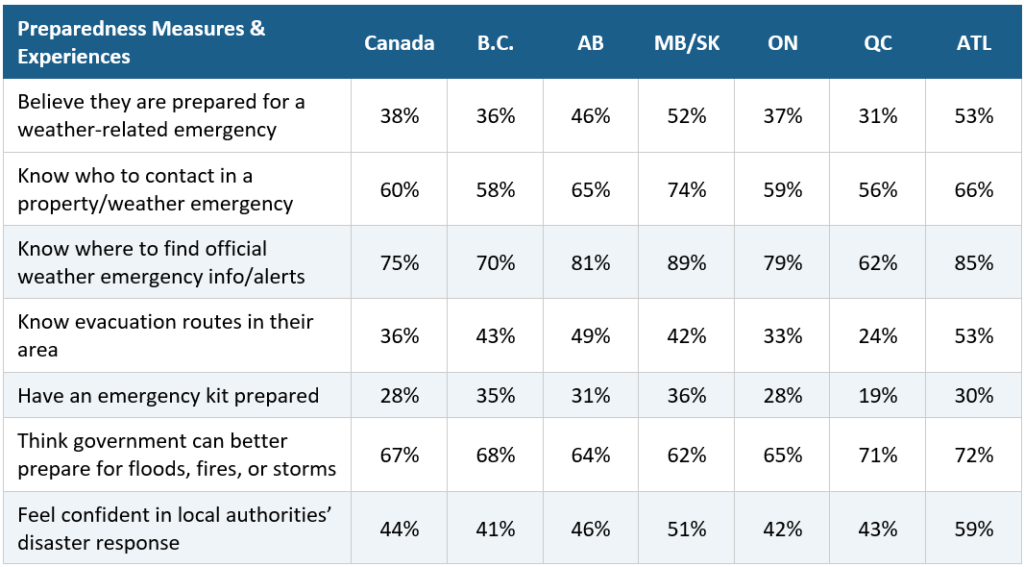
MISSISSAUGA, ON, MAY 5, 2026/insPRESS/ – As wildfires, floods, and extreme storms intensify across Canada, a new survey from First Onsite Property Restoration finds that most people are not ready for them. Just over one in four Canadians (28 per cent) have an emergency kit prepared—even as awareness of climate-driven risk has never been higher.
Released during Emergency Preparedness Week (May 3–9), the findings arrive as Public Safety Canada and partners are calling on Canadians to “Be Prepared and Know Your Risks.”
The survey findings highlight a clear disconnect between awareness and action. Three quarters of Canadians (75 per cent) say they know where to find official weather emergency information and alerts. Yet only 38 per cent feel they are prepared for a weather-related emergency.
The gap is perhaps sharpest when it comes to basic preparedness. Just 36 per cent of Canadians – homeowners and businesses alike – know their local evacuation routes. This is striking for a country that has watched wildfires, floods, and major storms reshape communities in recent years. Two thirds of Canadians (67 per cent) believe all levels of government could be doing more on disaster preparedness, while only 44 per cent feel confident in their local authorities’ disaster response.
“The steps taken before a catastrophic event can define the recovery. An emergency kit, a plan, knowing your route – these are not dramatic measures. They are what separates preparedness from panic,” said Jim Mandeville, SVP, First Onsite Property Restoration.
Pets, phones, and cash: What Canadians would grab on the way out
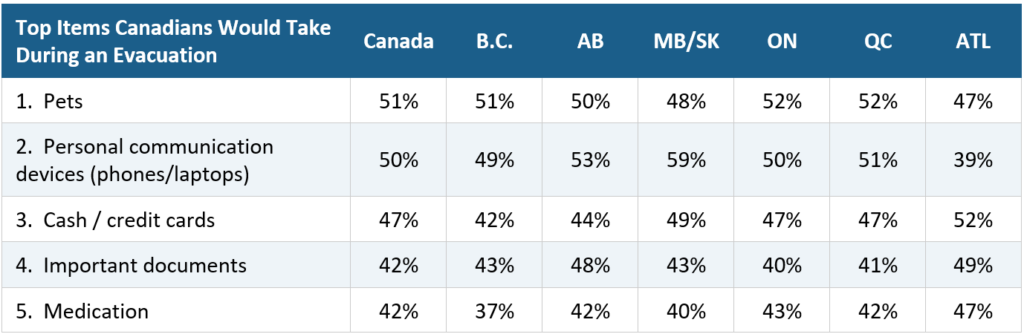
When Canadians and business owners were asked what they would take if they had to flee, the answers revealed their true priorities. Pets top the list at 51 per cent, followed by phones and laptops at 50 per cent, cash and credit cards at 47 per cent, and important documents and medication at 42 per cent each. After the top five, the numbers drop off steeply – emergency go-bags, food, and first aid kits rank well below the instinctive grabs of pets, phones, and wallets.
The prominence of phones reflects how central connectivity plays a role in modern emergency response. A charged device is no longer a convenience – it is a lifeline. And while phones have become the lifeline families rely on when everything else breaks down, that instinct is far more effective when people already have a plan.
“Know your key contacts before a disaster strikes – local emergency services, your insurance provider or broker, your utility companies, and a trusted restoration provider. In the chaos of a weather-related catastrophe, finding those numbers should be the last thing on your mind,” said Mandeville.
Preparedness by the numbers: Full survey results by province
Source: First Onsite Weather and Property Survey, Angus Reid Forum, 2026. n=1,505.
Evacuation priorities: What Canadians would grab first
Source: First Onsite Weather and Property Survey, Angus Reid Forum, 2026. n=1,505.
Tools for preparedness
Emergency Preparedness Week is a timely reminder that resilience is built before a crisis, not during one. To help Canadians and businesses close the gap between awareness and action, First Onsite offers free resources, including:
A disaster supply kit checklist: Includes must-have items like food, water, medications, first aid supplies, documents, and special needs items.
About the First Onsite Weather and Property Survey
These findings are from a survey conducted by First Onsite Property Restoration from February 20th to February 23rd, 2026, among a representative sample of 1505 online adult Canadians who are members of the Angus Reid Forum. The survey was conducted in English and French. For comparison purposes only, a probability sample of this size would carry a margin of error of +/-2.53 percentage points, 19 times out of 20.
About First Onsite: North America’s Trusted Leader in Property Restoration
First Onsite Property Restoration is one of the largest and fastest-growing emergency response planning, mitigation, and reconstruction service providers in North America. First Onsite employs over 2,500 team members and operates from more than 100 locations across Canada and the U.S. With a culture focused on harnessing the human power of its team members and a commitment to doing what’s right, the First Onsite team helps clients restore, rebuild, and rise. First Onsite is a subsidiary of FirstService Corporation. For more information, go to firstonsite.ca or follow First Onsite on LinkedIn.
La majorité des Canadiens ne sont pas prêts en cas de catastrophe – seulement 1 sur 4 a une trousse d’urgence
Les Canadiens privilégient les animaux, les téléphones et l’argent lors d’une évacuation : sondage de First Onsite
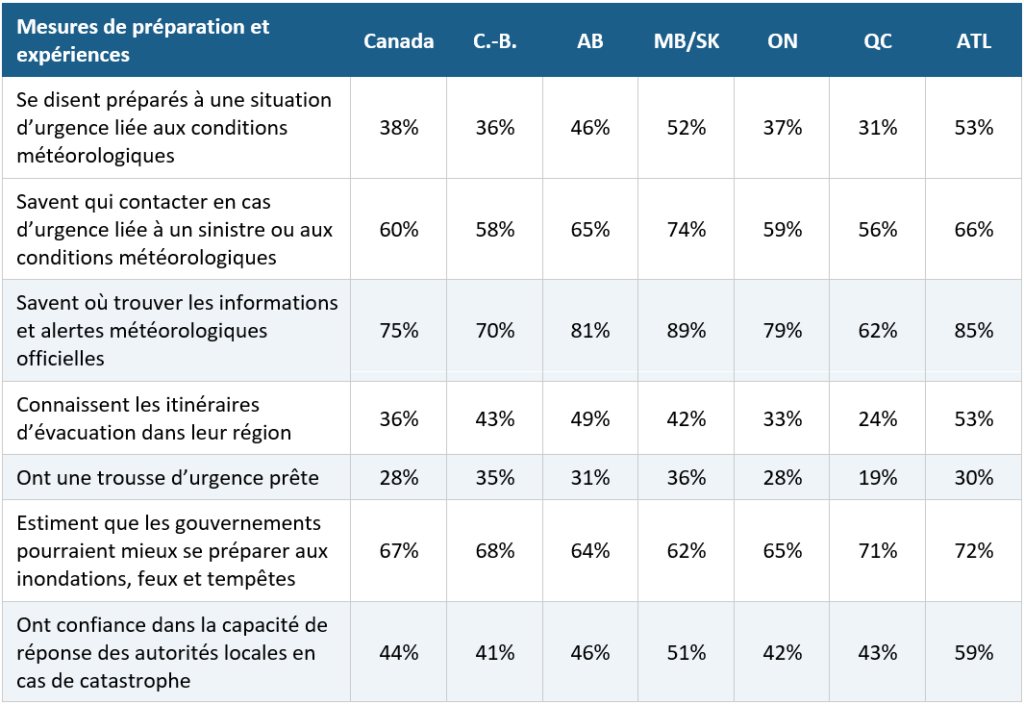
MISSISSAUGA (ONTARIO) – 5 MAI 2026 /insPRESS/ – Alors que les feux de forêt, les inondations et les tempêtes extrêmes s’intensifient partout au Canada, un nouveau sondage de First Onsite Restauration Après Sinistre révèle que la plupart des Canadiens n’y sont pas préparés. Un peu plus d’un Canadien sur quatre (28 %) dispose d’une trousse d’urgence, même si la sensibilisation aux risques liés au climat n’a jamais été aussi élevée.
Publié dans le cadre de la Semaine de la sécurité civile (du 3 au 9 mai), ce sondage paraît alors que Sécurité publique Canada et ses partenaires invitent les Canadiens à « se préparer et connaître leurs risques ».
Les résultats mettent en évidence un décalage marqué entre la sensibilisation et l’action. Les trois quarts des Canadiens (75 %) affirment savoir où trouver de l’information officielle et des alertes météorologiques d’urgence. Pourtant, seulement 38 % se sentent prêts à faire face à une situation d’urgence liée aux conditions météorologiques.
L’écart est particulièrement évident en ce qui concerne les bases de la préparation. À peine 36 % des Canadiens – particuliers comme entreprises – connaissent les itinéraires d’évacuation de leur région. Ce constat est frappant dans un pays qui a vu, ces dernières années, des feux de forêt, des inondations et des tempêtes majeures transformer des communautés entières. Par ailleurs, les deux tiers des Canadiens (67 %) estiment que les gouvernements pourraient en faire davantage en matière de préparation aux catastrophes, tandis que seulement 44 % se disent confiants quant à la capacité de réponse de leurs autorités locales.
« Les mesures prises avant un événement catastrophique déterminent souvent la qualité du rétablissement. Avoir une trousse d’urgence, un plan et connaître son itinéraire d’évacuation – ce ne sont pas des mesures spectaculaires, mais elles font toute la différence entre la préparation et la panique », a déclaré Jim Mandeville, vice-président principal chez First Onsite Restauration Après Sinistre.
Animaux, téléphones et argent : ce que les Canadiens emporteraient
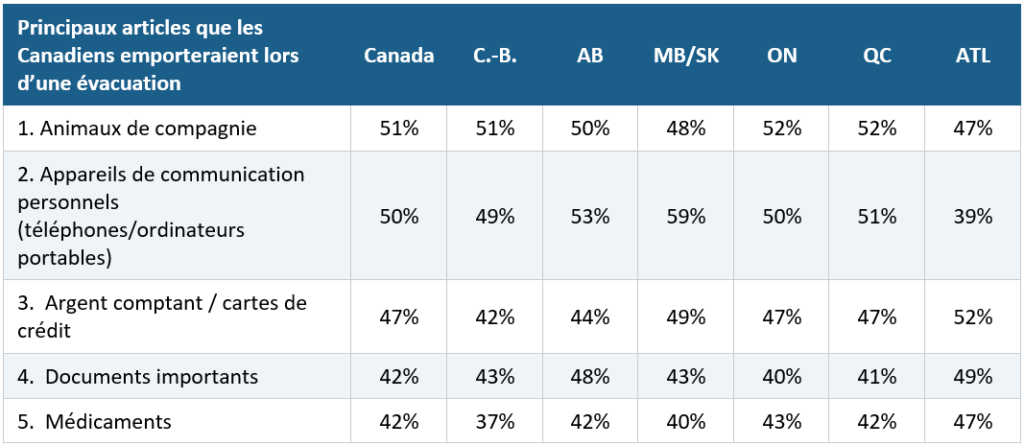
Lorsqu’on leur a demandé ce qu’ils emporteraient en cas d’évacuation, les réponses des Canadiens et des propriétaires d’entreprise révèlent leurs priorités réelles. Les animaux arrivent en tête (51 %), suivis des téléphones et ordinateurs portables (50 %), de l’argent et des cartes de crédit (47 %), puis des documents importants et des médicaments (42 % chacun). Après ces cinq éléments, les résultats chutent nettement : les trousses d’urgence, la nourriture et les fournitures de premiers soins se classent bien en dessous des réflexes d’emporter ses animaux, ses appareils et son portefeuille.
L’importance accordée aux téléphones reflète le rôle central de la connectivité dans la gestion moderne des urgences. Un appareil chargé n’est plus un simple outil pratique – c’est une véritable bouée de sauvetage. Toutefois, cette dépendance est beaucoup plus efficace lorsque les personnes disposent déjà d’un plan. « Identifiez vos contacts clés avant qu’une catastrophe ne survienne – services d’urgence locaux, assureur ou courtier, fournisseurs de services publics et partenaire en restauration. Dans le chaos d’un événement météorologique majeur, chercher ces informations devrait être la dernière de vos préoccupations », a ajouté M. Mandeville.
La préparation en chiffres : résultats complets du sondage par province
Source : Sondage First Onsite sur la météo et les sinistres, Forum Angus Reid, 2026. n = 1 505.
Priorités en cas d’évacuation : ce que les Canadiens emporteraient en premier
Source: First Onsite Weather and Property Survey, Angus Reid Forum, 2026. n=1,505.
Outils de preparation
La Semaine de la sécurité civile rappelle que la résilience se construit avant une crise, et non pendant. Pour aider les Canadiens et les entreprises à combler l’écart entre la sensibilisation et l’action, First Onsite met à disposition des ressources gratuites, notamment :
Liste de vérification pour une trousse d’urgence : comprend les éléments essentiels tels que nourriture, eau, médicaments, fournitures de premiers soins, documents importants et articles pour besoins particuliers.
À propos du sondage First Onsite sur la météo et les propriétés
Ces résultats proviennent d’un sondage mené par First Onsite Property Restoration du 20 au 23 février 2026 auprès d’un échantillon représentatif de 1 505 adultes canadiens en ligne, membres du Forum Angus Reid. Le sondage a été réalisé en anglais et en français. À titre comparatif seulement, un échantillon probabiliste de cette taille comporterait une marge d’erreur de ± 2,53 points de pourcentage, 19 fois sur 20.
À propos de First Onsite : Le leader nord-américain de confiance pour la restauration de biens
First Onsite Restauration Après Sinistre est l’un des plus importants fournisseurs de services de planification d’intervention d’urgence, d’atténuation et de reconstruction, et l’un de ceux connaissant la croissance la plus rapide en Amérique du Nord. L’entreprise emploie plus de 2 500 membres d’équipe et exerce ses activités à partir de plus de 100 emplacements au Canada et aux États-Unis. Grâce à une culture axée sur la valorisation du potentiel humain et à un engagement à agir avec intégrité, l’équipe de First Onsite aide ses clients à restaurer, reconstruire et se relever après un sinistre. First Onsite est une filiale de FirstService Corporation. Pour plus d’informations, consultez le site firstonsite.ca ou suivez First Onsite sur LinkedIn.
RELATIONS AVEC LES MÉDIAS : Sierra LeBlanc MAVERICK Relations publiques 647-405-2196 sierra@wearemaverick.com
In a priority dispute over an auto accident that happened 20 years ago — a case that’ ha’s already gone to the Supreme Court of Canada and back again — the Court of Appeal for Ontario has provided the latest twist in a flip-flopping legal saga.
In Chubb Insurance Company of Canada v. Zurich Insurance Company, the Ontario Court of Appeal found last week that by not paying out accident benefits first — as required by Ontario’s priority dispute rules — and then by not notifying the second payer within 90 days of a priority dispute claim, Chubb Insurance Company of Canada is on the hook to pay for the entire amount of the claimant’s benefits permanently.
The upshot is that Chubb has to pay Zurich Canada almost $1 million to reimburse Zurich for accident benefits it paid to a catastrophically impaired claimant.
Background
Sukhvinder Singh was in an accident while driving a rental car in 2006. No other vehicle was involved. She did not report the crash to the car rental agency.
The rental vehicle at Wheels 4 Rent was insured by Zurich, which Singh did not know.
At the time, Singh believed Chubb was the insurer, and her lawyer contacted Chubb to confirm coverage. Chubb also issued a policy to the rental agency that provided optional accidental death and dismemberment insurance. Singh did not purchase Chubb’s optional coverage.
After experiencing symptoms following her crash, Singh applied for accident benefits from Chubb, thinking she had seen Chubb’s name somewhere at the rental vehicle site. On Nov. 21, 2006, Chubb denied her application, stating: “This is not a personal automobile policy and thus the coverage of Ontario Statutory Accident Benefits does not apply.”
More than a year and a half later, on May 28, 2008, Chubb advised Singh’s lawyer that Zurich was Wheels 4 Rent’s auto insurer. Once Zurich became aware of the claim, it agreed to adjust it, pending the outcome of its priority dispute with Chubb.
The case reached the Supreme Court, where Chubb argued the link between Singh and Chubb was not strong enough for Chubb to be considered an ‘insurer,’ as defined in the province’s Statutory Accident Benefits Schedule. But the Supreme Court found there was a sufficient connection between Singh and Chubb, since Chubb was an optional benefits insurer and Singh probably knew about this because of something she saw at the rental agency. Chubb was therefore ruled an ‘insurer’ under the priority dispute rules.
Chubb then assumed carriage of the claim, chose to settle out with Ms. Singh (for more than the near-$1 million already paid out on the claim). Chubb then said that the SCC decision did not address all of the issues that were originally before the arbitrator, and thus, the matter needed to go back.
The original arbitrator, Stan Tessis, had passed away and so the court appointed a new arbitrator, Douglas Cunningham. Among other things, he was asked to resolve the issue of whether there wa a deflection of Singh’s claim, and if so, by who, and with what repercussions.
The arbitrator’s decision then flip-flopped its way back up to the Court of Appeal for Ontario. This time, the dispute was over which insurer was responsible for the amount Zurich paid out to Singh once it became aware of the claim. Zurich paid out $$998,387 to Singh, whose claim by then was deemed a catastrophic injury.
An arbitrator ruled Chubb had to reimburse Zurich for the total amount, since Chubb was the first payor and it did not give Zurich the required 90-day notice of a priority dispute. But on appeal, Ontario’s Superior Court ruled both Chubb and Zurich had to split responsibility for the payment.
Ontario’s Court of Appeal overturned that decision, finding Chubb owed the full amount.
“When Chubb received the claim, it simply refused to pay; it made no efforts to identify Zurich as an insurer,” a unanimous three-judge panel of the Ontario Court of Appeal found. “Given that Chubb had a relationship with Wheels 4 Rent, it would have been easy for Chubb to identify and notify Zurich as the correct insurer.
“Instead, Chubb waited a year and a half to provide this information to Ms. Singh. By this point, Ms. Singh was left without benefits and her condition had seriously worsened. In addition, given the delay, Zurich was not able to investigate and adjust the claim in a timely way.
“Section 2 of the [priority dispute regulations] is designed to guard against the type of harm Ms. Singh experienced; the provision is meant to ensure that disputes between insurers do not interfere with the prompt payment of claims to people who were injured in motor vehicle accidents.
“Section 3 is designed to guard against the prejudice Chubb’s delay in notifying Zurich caused; the insurer who is ultimately responsible for paying a claim should have a chance to investigate as soon as possible after the accident to adjust the claim and assess its risk.
“Given the circumstances of this case, the second arbitrator made no errors in exercising his discretion to require Chubb to pay the full amount of benefits owed to Ms. Singh permanently.”
Editor’s Note: The story has been updated to correct the original reporting, which inaccurately stated the Supreme Court had sent the matter back to arbitration. In fact, Chubb found the Supreme Court did not address matters that needed further arbitration. CU apologizes for the error.