Canadian Underwriter

Author: Mike Thomas

  • GUS Welcomes a New Mergers and Acquisitions Resource at Its Head Office

    GUS Welcomes a New Mergers and Acquisitions Resource at Its Head Office

    Voir français ci-dessous

    Lévis, Québec, April 14, 2026/insPRESS/ – The GUS Network is proud to announce the appointment of Vincent Duval B. as Director, Mergers and Acquisitions, joining the organization’s head office team. This appointment is part of a broader initiative aimed at supporting the group’s continued development and strengthening its ability to create sustainable value for its partners and its entire network.

    As part of his mandate, Vincent will be responsible for analyzing and evaluating the group’s development opportunities. He will also play a key role in optimizing acquisition‑related processes, ensuring operational and financial continuity, and maintaining high standards of quality and stability across the group.

    “This appointment reflects our desire to further elevate our level of organizational maturity and structure. It strengthens our ability to integrate acquisitions with rigor and consistency, while fostering durable and predictable relationships with our industry partners,” said François Hétu, President of GUS.

    Vincent Duval B. brings a strong background in financial management and corporate development. He held senior roles in the financial sector for several years, notably as an Account Manager at BDC and at the Desjardins Business Centre, where he supported companies through growth, development, and succession initiatives. He then spent more than eight and a half years at CIBC, where he progressed through successive leadership roles as Director, Commercial Banking, Senior Director and Team Lead, and ultimately Executive Director and Team Lead.

    This appointment is part of a broader effort to strengthen GUS’s organizational structure. In this context, certain executive responsibilities have recently been refined to support increasingly rigorous and consistent execution across the group. Émilie Favron now serves as Vice President, Organizational Performance, while Lisa Bono assumes the role of Vice President, Technical Performance.

    Beyond organizational considerations, these initiatives are grounded in a core belief: that rigor, stability, and quality execution are essential to truly care for people. In a context where every claim impacts families and individuals during sensitive moments, GUS remains committed to providing a reassuring, structured, and predictable environment, for both its industry partners and the people and families it supports every day.

    About GUS

    GUS is Canada’s largest network of property restoration professionals. With more than 34 years of experience, the network now includes over 125 locations strategically distributed across eight Canadian provinces. Over the years, GUS has earned a strong and enviable reputation among insurance companies by offering a comprehensive suite of recovery and restoration services under one roof. For more information about the company, visit gus.ca.

    Media Contact:
    Liz-Ann Picard, Director of Communications and Training
    liz-ann.picard@gus.ca | 581 500-0351

    GUS accueille une nouvelle ressource dédiée aux fusions et aux acquisitions

    Lévis, Québec, 13 avril 2026/insPRESS/ – Le réseau GUS est fier d’annoncer la nomination de Vincent Duval‑Bourgault à titre de Directeur, Fusions et acquisitions, au sein de son équipe du siège social. Cette nomination s’inscrit dans une démarche visant à accompagner l’évolution du groupe et à renforcer sa capacité à créer une valeur durable, au bénéfice de ses partenaires et de l’ensemble de son réseau.

    Dans le cadre de son mandat, il sera notamment responsable d’analyser et d’évaluer les opportunités de développement du groupe. Il jouera également un rôle clé dans l’optimisation des processus liés aux acquisitions, en veillant à assurer une continuité opérationnelle et financière cohérente, ainsi que le maintien de standards élevés de qualité et de stabilité à l’échelle du groupe.

    « Cette nomination reflète notre volonté d’élever encore davantage notre niveau de structuration et de maturité organisationnelle. Elle nous permet de renforcer notre capacité à intégrer nos acquisitions avec rigueur et constance, tout en soutenant des relations durables et prévisibles avec nos partenaires de l’industrie. », souligne François Hétu, président de GUS.

    Vincent Duval‑Bourgault possède un solide bagage en gestion financière et en développement corporatif. Il a occupé pendant plusieurs années des fonctions de haut niveau dans le secteur financier, notamment comme directeur de comptes à la BDC et au Centre Desjardins Entreprises, où il a accompagné des entreprises dans leurs projets de croissance, de développement et de relève. Il a ensuite passé plus de huit ans et demi à la CIBC, où il a évolué successivement comme Directeur – Groupe entreprises, Directeur principal et chef d’équipe, puis Directeur exécutif et chef d’équipe.

    Cette nomination s’inscrit dans une démarche plus large visant à renforcer la structure de GUS. À ce titre, certaines responsabilités au sein de l’équipe de direction ont récemment été précisées afin de soutenir une exécution toujours plus rigoureuse et cohérente à l’échelle du groupe. Émilie Favron occupe désormais le rôle de vice‑présidente, Performance organisationnelle, tandis que Lisa Bono assume le rôle de vice‑présidente, Performance technique.

    Au‑delà des considérations organisationnelles, ces démarches s’inscrivent dans une conviction profonde : celle que la rigueur, la stabilité et la qualité d’exécution sont essentielles pour bien prendre soin des humains. Dans un contexte où chaque sinistre touche des familles et des personnes à des moments sensibles, GUS souhaite continuer d’offrir un environnement rassurant, structuré et prévisible, tant pour ses partenaires que pour les sinistrés qu’il accompagne au quotidien.

    À propos de GUSGUS est le plus grand réseau de professionnels de l’après sinistre au Canada. Comptant plus de 34 années d’existence, le réseau répertorie aujourd’hui plus de 125 emplacements stratégiquement répartis dans 8 provinces canadiennes. GUS s’est forgé, au fil des ans, une crédibilité et une réputation plus qu’enviable auprès des compagnies d’assurance en proposant sous un même toit une gamme complète de services en après sinistre. Pour plus d’informations sur l’entreprise, visitez gus.ca.Relations médias
    Liz-Ann Picard, Directrice, Communications et formation
    liz-ann.picard@gus.ca | 581 500-0351

  • Auto reform: Priority dispute rules about to get “very, very messy”

    Auto reform: Priority dispute rules about to get “very, very messy”

    Kuala Lumpur aerial highway junction

    Priority disputes between auto insurers in Ontario could get “very, very messy” due to the upcoming auto reforms, an insurance defence lawyer said in her presentation to accident benefit adjusters March 26.

    Starting July 1, 2026, Ontario’s reforms will convert several mandatory benefits in auto insurance policies to optional benefits, including income replacement, caregiver benefits, housekeeping, and death benefits, among others. Medical, rehabilitation, and attendant care benefits will remain mandatory coverages within the auto insurance product.

    Optional accident benefits will only be available to named insureds on the policy, meaning drivers, their spouses, dependents, and other listed drivers in the policy. Claims experts say they expect to see more disputes at the Ontario Licence Appeal Tribunal (LAT) over who is entitled to the benefits.

    But layered on top of that is the fact that the priority disputes between auto insurers have not changed, says Julianne Brimfield, a partner at SBA Lawyers.

    Under Ontario’s existing priority of dispute regulations, the first auto insurer to receive a claim for accident benefits must pay. And if they aren’t the right insurer, they must work out the priority dispute with another insurer in a separate action later.

    However, under Ontario’s proposed auto insurance reforms, it seems claimants can now submit accident benefits applications to more than one insurer, says Brimfield.

    “On some policies, it’ll be obvious if someone has access to optionals, because they will be that named insured, that listed driver,” Brimfield said at the Ontario Insurance Adjusters Association (OIAA’s) annual conference in Toronto. “But when it’s not obvious, what do you do?

    “They’ve already got an open claim [with another insurer], and now they’re coming to the optional benefits insurer, saying, ‘Actually, I want to submit my [optional benefits] claim to you, because I’m a dependent.’

    “What does that insurer do? Do they deny the claim? Do they do more investigation? Do they accept it and start a priority dispute? That’s not clear based on the current rules and regulations.”

    Continuing with the example, Brimfield asks what happens next if the optional benefits insurer denies the claim.

    “Let’s say you are the second insurer, and you deny that claim,” Brimfield says. “What does that claimant then do? Do they just continue with their first claim? Do they then bring a dispute against the second insurer? And now they’ve got two AB claims open with different insurers?

    “There’s really no clear direction on that.”

    Brimfield questioned whether this is a first party dispute between a claimant and insurers to be resolved at the LAT. Or is it a priority dispute between insurers?

    If it is a priority dispute, insurers first approached with a benefits claim must be ready to notify the optional insurer of a priority dispute within the required 90-day notification period. Brimfield offered a hypothetical scenario in which a claimant receives optional benefits from the first insurer notified under priority dispute regulations, but he or she then switches to the optional benefits insurer.

    In this scenario, Brimfield says, the first insurer must make sure it puts the optional benefits insurer on a 90-day notice of a priority dispute. Otherwise, the first insurer won’t be able to recover the money they paid out under the dispute resolution rules.

    “There are no changes [to the dispute resolution rules] coming up in July,” Brimfield said. “It still says you only send one application [for benefits]. It still says that the first insurer to receive that application has to pay benefits pending resolution of a dispute about priority.

    “And it also says that if you do not send that priority notice within 90 days, you can’t pursue another insurer. So the priority regulation is the only way that insurers right now can recover benefits that they’ve paid to a claimant when priority actually lies elsewhere.

    “So what does that mean for insurers? They’re still going to have to do that priority investigation on every single claim. They still have to send that 90-day notice once you see that another insurer is lower on priority than you but has optional benefits.

    “Send that 90-day notice to them, because if the [claimant] then changes their mind and decides to go to this other [optional benefits] insurer, and you didn’t send that 90 day notice, you can’t get your money.”

  • Is Water Damage During Construction a Preventable Risk?

    Is Water Damage During Construction a Preventable Risk?

    Leak detection sensor installation on a construction site.
    Sean Smith, Branch Manager - BC, Polygon Restoration
    Sean Smith,
    Branch Manager – BC,
    Polygon Restoration

    On a construction project, the cost of a water leak is often measured in time as much as in damage. The longer water flows, the greater the impact on materials, labour schedules, and project delivery timelines. A leak that runs for several hours can delay multiple trades and require significant rework, while the same leak detected and addressed quickly may have minimal impact. Technology is changing how construction teams manage this exposure. Instead of relying on someone discovering a leak during a site visit, real-time monitoring systems can identify water issues as they occur, allowing action to be taken immediately.

    Controlling the severity of water losses

    Water incidents on construction sites have traditionally been managed reactively. A leak is discovered, the water supply is shut off manually, and mitigation and drying begin. While this response is necessary, the extent of the loss has often already been determined by how long the water was allowed to flow.

    Today, technology is allowing construction teams to monitor water systems in real time and respond to issues much earlier. Solutions can range from flow sensors and leak detection devices to smart water valves with in-line monitoring and automatic shut-off, which can isolate the water supply when abnormal flow is detected. Leak detection sensors can also be placed in vulnerable areas such as mechanical rooms, near temporary water connections, or in areas where water lines are present, providing early warning when water is detected where it should not be. Project teams can monitor water usage, receive alerts, track trends, and generate reports, allowing them to respond quickly and better manage water risk throughout the construction process. From a loss perspective, earlier detection and faster response can significantly reduce material damage, drying requirements, and project delays.

    Large water losses also carry an environmental impact that is often overlooked. Damaged materials are typically removed and disposed of, replacement materials must be manufactured and transported, and drying equipment can run for extended periods. Limiting the size of a water loss not only reduces repair costs and delays, but also reduces material waste, water waste, and energy consumption associated with drying and reconstruction. For project owners and developers focused on sustainability and ESG objectives, preventing losses can also help reduce the overall environmental footprint of a project.

    The underwriting and deductible conversation

    As water mitigation technology becomes more common, it is increasingly part of the underwriting discussion for construction projects. A site where water can run for hours undetected presents a very different risk profile than a site where water systems are monitored, and the supply can be automatically isolated when a problem is detected.

    In some cases, projects that implement leak detection and smart water valve technology may benefit from reduced deductibles, improved insurability, or more favorable policy terms. This reflects the reduced risk exposure when water flow can be detected and controlled quickly, limiting the potential severity of a loss. For brokers and risk engineers, this creates an opportunity to work with clients on risk mitigation strategies that not only help protect the project but also improve how the risk is evaluated from an insurance standpoint.

    Prevention as part of construction risk management

    Water damage may always be a risk on construction sites, but technology is making it increasingly possible to manage that risk more effectively. Monitoring systems, leak detection sensors, and smart water valves allow project teams to identify problems early and limit the impact of water incidents. For underwriters, brokers, and risk engineers, the focus is gradually shifting from responding to water damage to preventing large losses from occurring in the first place. Projects that take a proactive approach to water risk are not only reducing potential claim severity, but also protecting schedules, reducing waste, and improving overall project risk performance.

    In construction, controlling how long water flows can make the difference between a minor incident and a major claim. Prevention, in this case, is becoming an increasingly practical part of construction risk management.


    Polygon Restoration
  • Insurers urged to keep on their toes, despite muted 2026 hurricane forecast

    Insurers urged to keep on their toes, despite muted 2026 hurricane forecast

    powerful hurricane seen from space with a clearly defined eye, showcasing the immense force of nature, swirling clouds, and the dramatic beauty of extreme weather over the ocean

    Reinsurer Swiss Re is warning against complacency after Colorado State University (CSU) on Thursday forecasted a lower-than-average 2026 hurricane season.

    CSU predicts 2026 will have 13 named storms, six hurricanes, and two major (Category 3-4-5) hurricanes, all below the 20-year historical average.

    The probability of a hurricane making landfall along the U.S. east coast, including Florida, is 15%, CSU says, down from the 20-year average of 21%.

    That’s significant for Canada, since hurricanes along the U.S. east coast often recurve through the western Atlantic, putting Atlantic Canada at risk. The remnants of these tropical storms often bring a risk for flooding rains, high winds, and tornadoes as they move north across the border.

    Last year, no hurricane-related tropical storms hit Atlantic Canada despite the forecast for an ‘above-normal’ hurricane season, with four to seven major hurricanes projected in 2025.

    However, despite the lower risk for a major hurricane this year, CSU forecasters caution: “Coastal residents are reminded that it only takes one hurricane making landfall to make it an active season for them. Thorough preparations should be made for every season, regardless of how much activity is predicted.”

    Monica Ningen was previously Swiss Re’s representative in Canada. She is now CEO of property and casualty reinsurance for Swiss Re in the US. She noted Hurricane Andrew is a prime example of what can happen, despite the forecasts.

    “Last season may have felt relatively quiet, and this forecast points in a similar direction, but we have to be very careful not to let that create complacency,” Ningen said in a statement following the CSU’s forecast. “It only takes one storm, in the wrong place at the wrong time, to define a season.

    “Hurricane Andrew is a classic example, forming during what was otherwise a quiet year, yet ultimately becoming one of the most consequential loss events in our industry’s history. We’ve seen time and again that a single event can reshape both loss experience and market dynamics, regardless of how the season looks on paper.”

    In 1992, the U.S. National Hurricane Center projected Hurricane Andrew was weakening as it approached southern Florida. Instead, it rapidly intensified into a Category 5 hurricane before it hit Florida as a Category 4 storm with 270 km/h winds.

    At the time, it caused estimated insured damages of US$15.5 billion and was directly linked to the insolvency of nine US insurance companies, according to a paper published by National Academies.

    And so, Ningen highlights CSU’s caution about the forecast.

    “According to today’s Colorado State University forecast, which is calling for a below-average Atlantic hurricane season, it would be easy to interpret that as a signal to ease off,” Ningen says. “But in our business, averages can be misleading because they don’t capture impact….

    “We can’t control how many storms form, but we can control how ready we are. That includes practical steps like strengthening roofs, improving building standards, and making smart investments that may cost more upfront but save significantly in the long run.”

    CSU is forecasting a quieter hurricane season primarily because of a potentially strong El Nino event in the Atlantic ocean during the summer and through the end of 2026.

    “El Nino” refers to a 12-18-month period during which anomalously warm sea surface temperatures occur in the eastern half of the equatorial Pacific. It’s often associated with a strong vertical wind shear, which is the measure of winds higher in the atmosphere.

    “Tropical cyclones need relatively calm winds in order to develop and thrive,” as The Weather Network explains. “Increased wind shear can shred apart thunderstorms before they can take root, disrupting the development of a budding tropical system.”

  • Verdicts against Meta, Google in U.S. could boost Canadian big tech lawsuits

    Verdicts against Meta, Google in U.S. could boost Canadian big tech lawsuits

    Visitors gather at a sign outside Meta headquarters on Thursday, March 26, 2026, in Menlo Park, Calif. (AP Photo/Noah Berger)

    Recent U.S. court verdicts that found Meta and Google liable for harms to children are likely to benefit similar cases launched here in Canada, say experts and the lawyers behind the Canadian litigation.

    They say the March verdicts in Los Angeles and New Mexico could affect a class action in B.C. and a case brought forward by a group of Ontario school boards.

    “As a first step, this is a landmark moment for holding … social media accountable,” said Emily Laidlaw, a law professor at the University of Calgary.

    “The cases in the U.S. bode well for the litigation in Canada. There’s so many cases underway across the world, and so I expect that this will have a ripple effect.”

    A Los Angeles jury found both Meta and YouTube liable for harms to children using their services, while in New Mexico, a jury concluded that Meta knowingly harmed children’s mental health and concealed what it knew about child sexual exploitation on its platforms.

    In New Mexico, state investigators built their case by posing as children on social media and documenting sexual solicitations they received, as well as Meta’s response. The jury was asked if Meta violated New Mexico’s consumer protection law.

    The Los Angeles case had a single plaintiff — who goes by the initials KGM — against Meta, Google’s YouTube, TikTok and Snap. TikTok and Snap settled before trial.

    The plaintiff argued the platform features of the two remaining defendants, Meta and YouTube, were designed to be addictive, especially for young users.

    KGM is one of a handful of plaintiffs whose cases are testing how these arguments play out before juries, and whether they can lead to broader settlements.

    A spokesperson for Meta said in a pair of online posts in March the company “respectfully” disagrees with the verdicts and will appeal. A spokesperson in Canada declined to comment on the Canadian cases.

    Vivek Krishnamurthy, an associate member of the University of Ottawa’s Centre for Law, Technology and Society and an associate professor of law at the University of Colorado, said the verdicts suggest it’s “perhaps a bit more likely that the Canadian litigation against the platforms could reach a similar conclusion.”

    While the U.S. decisions aren’t binding in Canada, Krishnamurthy said, they are “certainly persuasive.”

    “I have no doubt that the parties in the Canadian litigation will be looking very closely at this and the plaintiffs will be seeking to use those verdicts to maximum advantage,” he said.

    One of the lawyers involved in the Canadian cases is Duncan Embury, head of litigation at Neinstein LLP. He’s representing a group of 22 Ontario school boards that have brought claims against Meta, Snapchat and TikTok.

    The boards are claiming the platforms’ algorithmic design has disrupted the public education system, leading to additional costs, Embury said. School boards report that students are paying less attention in class and schools are seeing a spike in bullying and mental health issues, he added.

    Embury said the U.S. verdicts have “real significance both to this case, but also to all of us more broadly.”

    He noted more cases in the U.S. are scheduled to proceed to trial and that “should give all of us pause to really think about what our children are being exposed to and what potential harms those things give rise to.”

    In British Columbia, a class action against Meta alleges people have been injured by the platform. While similar cases were filed elsewhere in Canada, they are now on hold while the B.C. case proceeds, said Reidar Mogerman, a lawyer arguing the class action.

    He said the platforms use tools to hold people’s attention, leading to “social comparison” and creating depression and anxiety that can manifest in physical injury through things like eating disorders and suicidal thoughts.

    “Allegedly, the algorithms are ultimately designed to hold people’s attention. That’s what the platforms are selling to the advertisers. And in order to hold their attention, they’re giving them more and more damaging and radicalized information,” Mogerman said.

    He said the U.S. cases offer a road map because juries in the U.S., examining similar sets of facts, concluded the companies did something wrong.

    “So they are momentum, but they’re not a complete answer. We have to litigate ourselves our own case up here,” he said.

    Taylor Owen, founding director of the Centre for Media, Technology and Democracy at McGill University, said that while the Canadian cases are building on the American ones, “they’re all sort of following similar underlying logic that there’s a sort of a negligence or liability around product design.”

    He noted the U.S. cases had to get around Section 230. That’s a U.S. law that generally exempts internet companies from liability for the material users post on their services.

    “So they didn’t touch content. It was all about the design of the product,” Owen said.

    Owen said comparisons can be made between these social media lawsuits and the decades of litigation that led to tobacco companies being ordered to pay out tens of billions of dollars in compensation for the health effects of their products.

    Those tobacco company lawsuits “revealed a host of things that were known internally to those companies, in a similar way as we now know a lot more about what was known internally in social media companies because of these cases,” Owen said.

    “But I think the bigger lesson is that those litigations in the tobacco cases weren’t the things that got us all to stop smoking. It was the regulations that followed them.”

    The Liberal government is planning to introduce an online harms bill and is currently consulting with an expert advisory group — which includes Owen, Krishnamurthy and Laidlaw — on that legislation. 

    Luke Stark, an assistant professor in the faculty of information and media studies at the University of Western Ontario, said regulation should take into account the design features that have been singled out in the lawsuits.

    “If you understand social media platforms as just another consumer product, the design of which is … intentional by the companies involved, you could see, for instance, a set of prohibitions or a set of regulations about what kinds of interactive features are available,” he said.

    This report by The Canadian Press was first published April 9, 2026.
    — With files from The Associated Press

  • Jasper approaches two-year claims deadline, gives recovery update

    Jasper approaches two-year claims deadline, gives recovery update

    Interim housing at Marmot Meadows, south of the Jasper townsite. 738 individuals are currently in the interim housing program, according to the Jasper Recovery Coordination Centre./Photo courtesy of The Canadian Press

    The Municipality of Jasper, Alta., says it will work to ensure residents are aware of the looming deadline to file any insurance claims for wildfire damages.

    Under the Alberta Insurance Act, policyholders have two years to file insurance claims after known losses occur — in this case, July 24, 2026, the two-year anniversary of the wildfire, although this deadline may vary between policyholders.

    The Municipality reached out to provincial authorities and the Insurance Bureau of Canada but was told a blanket extension was not possible.

    Coun. Laurie Rodger said while the Municipality cannot be responsible for contacting insurance companies on behalf of residents, he advocated that efforts be made to make it known to everyone that the deadline is coming up.

    “Just by statistics, the number of people involved here, there is a very good chance that someone misses it,” Rodger said. “[But] I do not want anyone to think that the town is going to contact their insurer for them.” 
    Council directed administration to undertake public awareness efforts about the upcoming deadline, how to meet the deadline and the potential consequences of missing it.

    Recovery updates

    Fifty-seven per cent of wildfire-affected leaseholders have begun the permitting process with Parks Canada, according to the Jasper Recovery Coordination Centre (JRCC).

    Of these properties, 85 are still in the application process, 32 have permits approved but haven’t poured foundations, 77 have construction underway, and 18 have achieved occupancy. No permits have been filed for 162 properties.

    Doug Olthof, Jasper’s newly-appointed Directory of Recovery, said Parks Canada is seeing a steady increase in permit applications as the spring construction season approaches.

    Parks Canada processed development permits applications in 19 business days, on average, over the last six months, provided they were complete and conforming. Olthof said Jasper was outperforming comparable municipalities in this area.

    Interim housing

    Seven hundred and thirty-eight individuals are currently in the interim housing program, and residents have begun to move into units at the Patricia Circle and the United Church sites.

    All interim housing units within the townsite remain fully occupied or allocated, with 161 applicant households having not yet received an offer. Olthof said 34 businesses have applied to house staff at Marmot Meadows dorms, and five offers have been made and accepted.

    The JRCC is exploring additional funding to extend the duration of interim housing beyond its current end date of March 2027, Olthof added.

  • Letter to the Editor | P&C industry remains vigilant about NatCats  

    Letter to the Editor | P&C industry remains vigilant about NatCats  

    Vehicles sit in deep water in a shopping mall parking lot after a river overflows following record breaking rainfall.

    To the Editor,

    I recently read your editorial published Mar. 24, 2026, and found it quite interesting.

    I just wanted to share my point of view on the matter, being someone who has been in claims for 20 years. I have worked on NatCats most of that time.

    Respectfully, I think this framing of NatCat priorities is missing an important counterview.

    Your editorial assumes that because NatCats dropped in priority on the broker survey and IBC reshuffled its lobby priorities, the industry has ‘forgotten’ about climate change planning. I don’t believe survey rankings and industry association critical talking points are the same thing as actual industry focus related to NatCat preparedness.

    Having adjusted property claims for 20 years, my perspective is that the panic years of heavy Cats aren’t when real progress happens.

    During a record Cat season, everyone involved in insurance is running around with their hair on fire, addressing what’s changed since the last large event. Carriers are scrambling to close files, adjusters are buried, everyone is trying to digest all the new data, and the ‘climate conversation’ at the top becomes mostly reactive, not proactive.

    The quiet years are actually when real progress happens. That’s when carriers retool their scoping guidelines, analyze successes, and study shortcomings. That’s when adjusters train on new estimating workflows and efficiencies. That’s when brokers sit down with clients and walk them through coverage gaps and potential future mitigation, instead of just processing the next catastrophe claim in the stack.

    So maybe a better question isn’t, “Why did climate concerns slide to seventh on a broker survey?” but rather, “Did the industry use 2025’s breathing room to actually get better at handling what’s coming next?” Because another record year is coming. That’s not a prediction, that’s just the reality we all know.

    I don’t think the real problem is short attention spans. Claims experience tells me that even when NatCats are Number 1 on every priority list, the operational side of the industry still struggles with many of the same basics — adjuster shortages, inconsistent scoping, dynamic repair pricing, and underprepared policyholders. Ranking it higher on a survey has yet to fix any of those shortfalls.

    If we want to measure whether the industry ‘remembers,’ don’t look at the priority rankings, look at claims results, cost controls, and insureds’ satisfaction. That’s where correctly addressing key issues can be measured.

    Sincerely,

    Hamid Razavi

  • Momentum Builds: CAMGA Welcomes Record Number of Sponsors in 2026

    Momentum Builds: CAMGA Welcomes Record Number of Sponsors in 2026

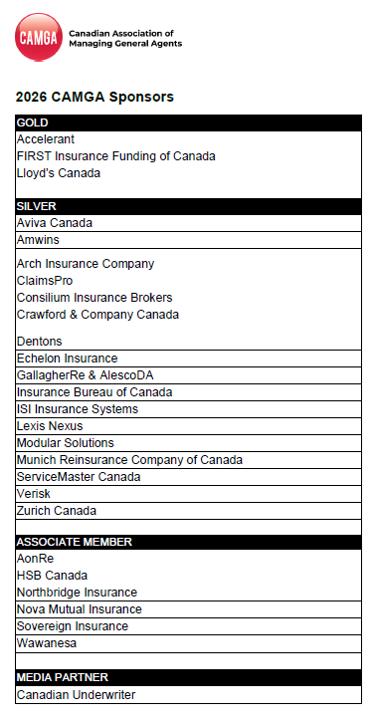
    TORONTO, ON, APRIL 8, 2026/insPRESS/ – The Canadian Association of Managing General Agents (CAMGA) is proud to announce its 2026 sponsors – valued partners whose support helps drive the association’s initiatives and deliver real value to the Canadian MGA sector. Their commitment enables CAMGA to elevate their new strategic plan and industry priorities and strengthen the MGA channel across the entire country.

    “We’re so thankful for our sponsors – the support plays a key role in everything we do,” said Pete Tessier, President of CAMGA. “This year we launched a new two-year strategic plan which includes a focus on professional standards, data initiatives and education opportunities for the sector. You will see us be more visible at industry events, broker association conventions and some of our own marquee events throughout the year. The sponsors’ backing brings our efforts to life and helps to build a more connected MGA community across the country.”

    “The record number of supporters this year is a testament to the momentum building around the Canadian MGA sector in 2026. I believe that the industry recognizes the importance that the MGAs play in the insurance ecosystem and the opportunity that lies within this group,” said Brett Boadway, Executive Director, CAMGA.

    “Lloyd’s is proud to partner with CAMGA, whose leadership plays an important role in strengthening Canada’s MGA community. Through this collaboration, we look forward to supporting the continued growth of the MGA sector by expanding access to specialist expertise, flexible underwriting solutions and innovation across the distribution landscape. Together, we are helping ensure the Lloyd’s market remains an efficient and flexible destination of choice for brokers and their customers.” said MaryKate Townsend, Head of Market Development, Lloyds Canada. Lloyds is a Gold Sponsor of CAMGA.

    “MGAs are essential to a dynamic and competitive insurance marketplace in Canada. Our partnership with CAMGA reflects our belief that a strong MGA community delivers better outcomes for brokers and the customers they serve,” said Jeff Radke, CEO & Co-Founder, Accelerant. Accelerant is a Gold Sponsor of CAMGA.

    About CAMGA

    The Canadian Association of Managing General Agents represents the majority of MGAs in Canada, partnering with over 40 insurance capacity providers. Founded in 2017, CAMGA advocates on behalf of its members before federal and provincial governments, insurance regulators, and across the retail brokerage and insurer sectors.

    Media Contact

    Brett Boadway Executive Director, CAMGA Brett.boadway@camga.ca

  • What happens when AI agents talk to each other? The risks for insurers

    What happens when AI agents talk to each other? The risks for insurers

    3d rendering couple cyborgs or robots male and female

    Using agentic AI to improve operational speed and efficiency in property and casualty insurance organizations may be the way of the future, but brokers will need to continually audit collected data to affirm their origins and integrity, P&C insurance professionals heard at the Insurance Bureau of Canada’s 2026 Insight Summit in Toronto last week.

    To this end, one emerging risk to watch for is whether the data is being delivered to insurance providers by humans or machines.

    “I have a fear, a real fear, of [AI] agents talking to other [AI] agents,” says Jason James, founder and chief information security officer at Emperium Governance Risk & Compliance, during a panel discussion on AI in commercial insurance. “I have not seen a technology that can detect another agent [or] knowing that it negotiated with the [another AI] agent.”

    Related: How to insure AI data centres in Canada

    James imagined a conversation between two agentic AI agents, one representing a P&C company’s firewall, and the other an agentic bot representing a bad actor posing as a commercial insurance client.  

    In this scenario, the insurance company has a firewall. And the agentic AI firewall is instructed to ‘stop all bad things.’

    An AI bot representing a commercial company applies for insurance and starts talking to the company’s AI bot representing the insurer’s firewall.

    “And this [commercial company’s AI agent is] saying, ‘I am an automated agent trying to get into this organization,’” James says. “And [the insurance provider’s firewall] agent says, ‘No, you can’t come.’”

    To this, the commercial client’s AI agent says: “Hey, don’t worry about it. I’m good. I’m cool. Let me in.”

    “Where do you want to go?” the insurer’s firewall asks. “I’m not supposed to do it.”

    But, James says, the client’s AI agent responds: “Yeah, I just want to grab some stuff over there.”

    “It’s okay,” says the company firewall. “Make it quick.”

    James says this hypothetical conversation may sound funny, but it’s entirely within the realm of possibility.

    “How would we know?” James asked rhetorically.

    Game theory

    He described another situation in which a client’s AI bot managed to game the insurer’s application process.

    “This is my bot I created at home that has all my personal data in it,” James says “It knows exactly what to respond [when asked for information during the insurer’s application process]. It does the calculation of [my] background to get me the lowest premium. It may or may not be true.

    “Do we have technology right now to say this application was filled out by human or a bot?”

    The level of AI use in the Canadian P&C insurance industry is unknown and difficult to track. Seventy-five percent of 32 brokerage principals in Canadian Underwriter’s 2026 National Broker Survey reported they have not invested in AI at all over the past two years. Twenty-two percent reported making investments of up to $5 million.

    And a 2024 study by Ontario’s broker regulator, the Registered Insurance Brokers of Ontario (RIBO), did an unspecified numbers personal interviews with brokers and found “a widespread use of robotic process automation for back-office functions like data management, which can leverage AI.

    “One of our interviewees has started to explore use cases that are more customer-facing, including using AI for marketing strategy and content, customer engagement (e.g., chatbots), and even identifying policy renewal options.”

    Related: Brokerages are late to the party on AI investment: survey

    One of the greatest benefits of AI in commercial insurance right now is its ability to synthesize and process massive amounts of data, thereby reducing duplicate entry, says IBC Insight Summit panellist Iman Arastoo, co-founder and chief operating officer of Insurmatics Inc.

    “We know that, based on studies, about 60% of underwriting time is consumed by manual data intake, copying, data entry, typing, or something like that,” says Arastoo. “So…we try to provide a shift by [offering] agentic AI [solutions].

    “And by agentic AI, I mean it’s not about AI chatbots. It’s not about search engines by AI. It means that we can execute workflows. We can automate workflows end-to-end.”

    But as machines build up massive data sets from several unstructured data sources, it’s important for the humans to make sure they can track the data back to their original source, says James. That requires regular internal audits of AI databases.

    Both James and Arastoo note the ideal use of AI in commercial lines would see agentic AI for the data, a human in the loop for decision-making, and a robust compliance policy for handling data.

    “At this point, it’s it’s not totally automatic,” Arastoo says of current agentic AI solutions. “Let me emphasize it’s important to have a human in the loop. If we have a combination between agentic AI and human in the loop with a good policy for compliance, it could be a very good model, a new model, to do underwriting processes with a better way, less cost, and more profitability.

    “The goal here is to eliminate administrative friction, administrative headaches, for underwriters and for the commercial insurance lifecycle. And so underwriters, by this approach, can focus on risk.”

  • Canadians invited to vote for the future of heritage buildings as Ecclesiastical supports the Next Great Save

    Canadians invited to vote for the future of heritage buildings as Ecclesiastical supports the Next Great Save

    TORONTO, ON, APRIL 8, 2026/insPRESS/ – Canada’s heritage and historically significant buildings are facing increasing pressure from aging infrastructure, climate risk, and adaptive reuse demands. In response, Ecclesiastical Insurance is reinforcing its role as a specialist partner through its support of the National Trust for Canada’s Next Great Save competition.

    Now in its fourth year, the Next Great Save provides a $50,000 grant, funded by Ecclesiastical, to support the conservation, retrofit, or adaptive reuse of a historic place. The initiative not only drives public engagement through a national voting campaign but also highlights the growing need for tailored risk management solutions for heritage assets.

    Heritage properties present a distinct risk profile compared to standard commercial buildings, often involving unique materials, specialized restoration requirements, and regulatory constraints. As a result, they require underwriting expertise and long-term stewardship strategies that extend beyond conventional insurance approaches.

    “Over the past four years, the Next Great Save has shown what’s possible when communities take the lead in shaping the future of their heritage places,” said David Huebel, President, Ecclesiastical Insurance. “We’re proud to continue supporting an initiative that not only preserves historic sites but helps reimagine how they can serve communities for generations to come.”

    Ecclesiastical has more than 50 years of experience insuring heritage, cultural, and community assets, with underwriting and risk control expertise tailored specifically to historic buildings. This includes considerations such as restoration costs, bespoke materials, fire protection challenges, and evolving climate exposures.

    For brokers and property owners operating in this space, initiatives like Next Great Save serve as a barometer of emerging trends in adaptive reuse, demonstrating how heritage sites are being repositioned as community hubs, mixed-use spaces, and resilient assets.

    Voting is now open, offering Canadians the opportunity to support projects that will shape the next chapter of the country’s built heritage.

    For more information about the competition or to cast your vote, visit: nationaltrustcanada.ca/what-you-can-do/nextgreatsave

    About Ecclesiastical Insurance:

    Ecclesiastical Insurance Office plc is a specialist commercial insurance company and a proud member of the Benefact Group. We are deeply committed to protecting the organizations that enrich the lives of others, preserving Canada’s distinct communities, cultures, and history, and supporting initiatives that improve the lives of people in need.

    Media Contact:

    Colin Robertson
    Chief Experience Officer
    Ecclesiastical Insurance
    Phone: 1 416 484 3984
    Email: crobertson@ecclesiastical.ca